



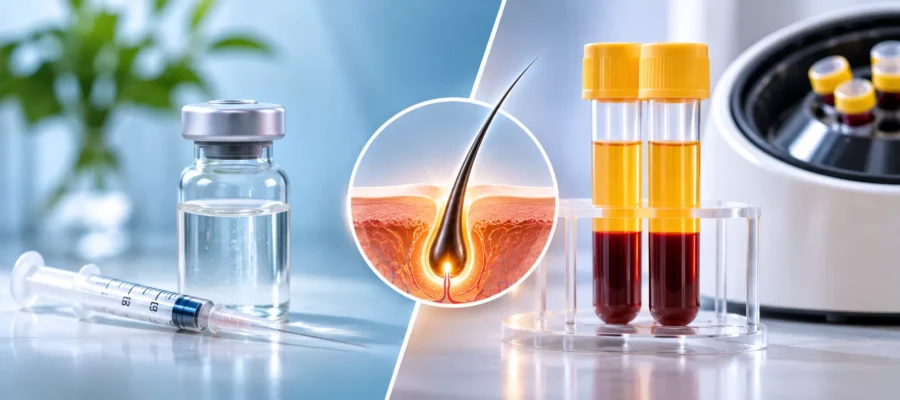
Neither procedure creates new follicles in an area where they have disappeared. Both are mainly considered when hair is still growing but has become thinner or less dense. Their limits matter, too.
What Is Hair Mesotherapy?
Hair mesotherapy involves a series of small injections into the scalp. The injected solution may contain vitamins, amino acids, minerals, peptides or medications. There is no single, standard mesotherapy formula. Products sold under the same name may contain different ingredients.
The aim is to deliver substances into the scalp. However, an ingredient that supports normal hair biology does not automatically prevent genetic hair loss when injected. For a closer look at the procedure, read Capilclinic’s guide to hair mesotherapy.
What Is PRP Hair Treatment?
PRP stands for platelet-rich plasma. A small blood sample is taken and placed in a centrifuge, which separates its components. The platelet-enriched portion is then injected into areas of thinning hair. Platelets contain growth factors involved in tissue repair and cell signaling, prompting research into hair growth.
Unlike mesotherapy cocktails, PRP does not rely on a premixed vitamin solution. It uses material obtained from the patient, although preparation methods and platelet concentrations differ. Capilclinic also explains PRP’s place in hair restoration in its hair transplant FAQs.
Hair Mesotherapy vs PRP: What Are the Main Differences?
The biggest difference is the material being injected. Their clinical evidence differs, too. PRP has been studied in more controlled trials for pattern hair loss, whereas mesotherapy covers many formulas that cannot be judged as one treatment.
| Feature | Hair Mesotherapy | PRP Hair Treatment |
|---|---|---|
| Injected material | Prepared solution with selected ingredients | Platelet-rich portion of the patient’s blood |
| Blood collection | Usually not required | Required before each treatment |
| Main approach | Local delivery of chosen substances | Delivery of platelet-derived growth factors |
| Standard formula | No universal formula | No single preparation protocol |
| Research | Limited and inconsistent across formulas | More trials, but results remain variable |
Both procedures use injections rather than surgery. A vitamin-based mesotherapy product is not interchangeable with PRP. Neither guarantees hair regrowth.
How Do Mesotherapy and PRP Affect Hair Follicles?
Hair follicles move through growth, transition and resting phases. In pattern hair loss, susceptible follicles gradually become smaller and produce finer strands. PRP is being investigated for its ability to influence signals involved in these phases. Some clinical studies have found improvements in hair density, but the size and durability of the benefit are not yet predictable.
Mesotherapy takes a different route. Its effects depend on the ingredients delivered, their concentration and the condition being treated. An injected vitamin blend is not the same as mesotherapy containing a prescription drug. Claims about stimulating every follicle deserve caution.
Which Treatment Has Better Evidence for Hair Growth?
PRP currently has stronger clinical evidence than standard vitamin-based mesotherapy for androgenetic alopecia, also called male or female pattern hair loss. A 2025 systematic review of randomized trials found that PRP may improve hair density and reduce shedding. However, protocols varied widely, and results are not consistent.
Mesotherapy research is harder to interpret because studies use different injected products. A systematic review found some promising outcomes, alongside inconsistent methods and reports of side effects. Importantly, neither treatment has the same established role as approved treatments such as topical minoxidil for appropriate patients. Injections should not delay an assessment of the actual cause of hair loss.
How Many Sessions Are Needed for Hair Mesotherapy and PRP?
Both approaches generally involve a course of appointments rather than a single injection. PRP research often uses an initial series of monthly sessions, followed by reassessment. Mesotherapy schedules are less consistent because different formulations have different proposed protocols. No session count guarantees regrowth.
| Treatment detail | Hair Mesotherapy | PRP |
|---|---|---|
| Typical appointment | Often around 20–30 minutes | Often around 30–60 minutes, including blood preparation |
| Initial course | Multiple sessions; interval depends on formulation | Frequently three or more sessions in clinical protocols |
| Follow-up | Based on response and product used | Reassessment, with maintenance sometimes proposed |
| Visible assessment | Usually after several months | Usually after several months |
Photos under consistent lighting are useful for monitoring progress. Hair growth is slow, and ordinary changes in shedding can easily be mistaken for treatment success or failure.
Who May Consider Hair Mesotherapy?
Hair mesotherapy is sometimes considered as an additional scalp treatment when the underlying hair loss condition has been identified. Its suitability depends especially on what the injected solution contains.
People exploring supportive treatment for early thinning, with realistic expectations about limited evidence.
Patients whose care plan includes a clearly identified mesotherapy ingredient, rather than an unspecified cocktail.
Individuals willing to attend repeated appointments and review their progress over several months.
People without known allergies or other reasons to avoid the proposed injected substances.
Who May Consider PRP for Hair Loss?
PRP is most often discussed for people who still have active follicles, particularly those with early or moderate pattern thinning. It does not replace testing when shedding starts suddenly or occurs in patches.
Men and women with diagnosed pattern hair loss who want to discuss an additional treatment option.
People with thinning areas where hairs remain, rather than completely smooth bald skin.
Patients who understand that any improvement may be modest and require follow-up sessions.
Individuals who can safely undergo a blood draw and scalp injections after medical screening.
What Are the Side Effects of Hair Mesotherapy and PRP?
Mild discomfort, tenderness, redness and small bruises can occur after either treatment. Because the scalp receives numerous injections, there is also a risk of infection if proper precautions are not followed. Mesotherapy introduces an additional concern: a person may react to one of the ingredients in the solution.
| Possible issue | Hair Mesotherapy | PRP |
|---|---|---|
| Temporary soreness or swelling | Possible | Possible |
| Bruising at injection sites | Possible | Possible |
| Reaction to injected ingredients | Depends on the formula | Less relevant to the plasma itself |
| Infection | Rare but possible | Rare but possible |
| Extra screening concerns | Allergies and product ingredients | Blood and platelet disorders, certain medicines |
PRP is often described as natural because it comes from the patient’s blood, but that does not make the procedure risk-free. People using blood-thinning medication, those with bleeding disorders, or anyone with an active scalp infection need careful screening. No prescribed medication should be stopped simply to receive cosmetic injections.
Can PRP or Mesotherapy Help After a Hair Transplant?
Both treatments are sometimes offered alongside hair transplantation, but supportive care and transplantation do different jobs. A hair transplant moves follicles from a donor area to regions with reduced coverage. Injections do not move follicles and cannot recreate the same coverage in areas with advanced baldness.
PRP has been investigated for post-transplant recovery and hair growth, while mesotherapy is sometimes included in broader aftercare plans. Evidence for routine use after surgery remains mixed. Timing is particularly important because a newly transplanted scalp needs to heal before further injections are considered. Capilclinic’s article on hair restoration techniques explores other approaches used with surgery.
Can Hair Mesotherapy and PRP Be Combined?
Combining them does not guarantee better results. Since mesotherapy solutions differ so widely, a combined plan is difficult to evaluate without knowing exactly what is injected and why. More treatments can also mean extra appointments, expense and exposure to injection-related side effects.
The first priority is identifying the type of hair loss. Gradual thinning at the crown calls for a different approach from sudden shedding after illness or hair loss caused by scalp inflammation. A clear diagnosis helps prevent unnecessary sessions and keeps attention on treatments that address the problem itself.
Hair Mesotherapy or PRP: Which Should You Choose?
For pattern hair loss, PRP has more supportive trial data than conventional nutrient-based mesotherapy, though the evidence still has limitations. Mesotherapy may be proposed for specific purposes, but its value cannot be assessed without the exact formulation. Neither option is a universal first choice, and both should be viewed as possible additions to a broader hair loss plan.
Before choosing, ask what diagnosis the treatment is meant to address, what will be injected, how progress will be measured and what happens if no change is seen. Those answers matter more than promises of fast regrowth. The aim is realistic care for the hair that remains.