



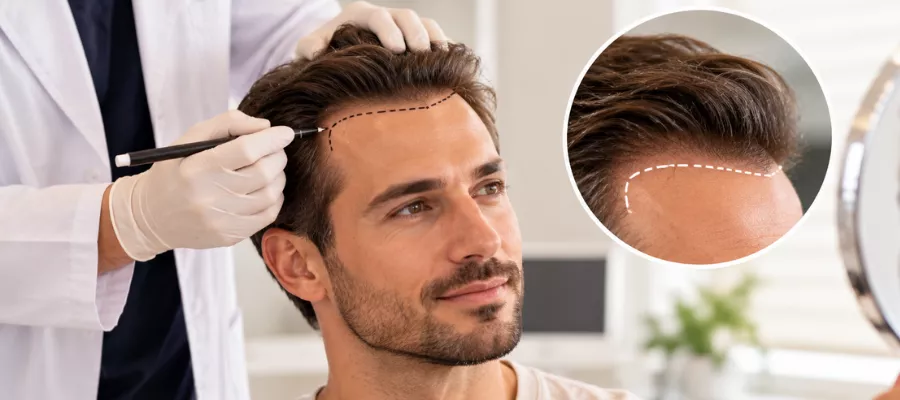
A natural hairline is designed before a hair transplant by assessing facial proportions, age, hair loss pattern, donor capacity, hair characteristics, and the likelihood of future thinning. The goal is not simply to draw a lower line across the forehead. A well-planned hairline should frame the face, blend with existing hair, and remain believable as the patient gets older.
This planning stage is one of the most important parts of a successful transplant. Good graft growth cannot fully compensate for an unnatural shape, poor angle, or overly aggressive placement. For that reason, patients considering a hair transplant should expect an individualized design before implantation begins.
Why Is Hairline Design So Important?
The frontal hairline is one of the first areas people notice. Small differences in height, curvature, density, and direction can affect whether the final result looks natural. A line that is too straight may appear artificial, while one placed too low can become difficult to maintain if native hair continues to recede.
What Does the Surgeon Evaluate Before Drawing the Hairline?
Before the scalp is marked, the medical team studies more than forehead height. Facial balance, temple recession, donor density, hair caliber, curl, skin-to-hair contrast, and existing miniaturized hair can all affect the design. Previous procedures or scars may also change the plan.
- Facial proportions, forehead height, temple shape, and symmetry are assessed.
- Age and likely progression of hair loss are considered.
- Donor density, hair thickness, texture, and curl are reviewed.
- Existing frontal hairs are checked for miniaturization.
- Previous transplants or scalp scars are taken into account.
- Styling preferences and expectations are discussed.
Patients who are unsure whether surgery is suitable can also review how candidacy for a hair transplant is assessed before focusing on the final hairline.
How Are Facial Proportions Used in Hairline Planning?
Facial proportions provide a useful reference but are not a rigid formula. Surgeons may consider forehead height, brow position, facial width, temple recession, and the relationship between different facial zones. The final outline should still be adapted to the individual.
| Feature | Why It Matters |
|---|---|
| Forehead height | Helps guide the starting level |
| Temple recession | Influences the frontal corners |
| Facial width | Affects overall hairline width |
| Existing hair | Helps grafts blend naturally |
| Age | Supports a sustainable design |
How Is the Correct Hairline Height Chosen?
The lowest possible hairline is not automatically the most natural. Lowering the frontal border requires more grafts and may create a look that becomes difficult to sustain if hair loss progresses. A slightly more conservative position can provide stronger visual density while using donor follicles more efficiently.
The proposed line is usually drawn directly on the scalp and reviewed from several angles. Small adjustments may be made while the patient is sitting upright because facial balance can look different from the front and side. The patient should understand the reason for the chosen height before surgery begins.
Why Should a Natural Hairline Not Be Perfectly Straight?
Natural hairlines contain small irregularities. Individual hairs do not emerge in a geometric row, and the transition between forehead skin and thicker hair is gradual. A hard, uniform border can therefore look artificial even when graft survival is good.
The leading edge is often softened with subtle irregularities and single-hair follicular units. Stronger multi-hair units can be positioned farther behind the front. This creates a gradual transition rather than an abrupt wall of hair.
How Are Grafts Distributed Across the Frontal Area?
Hairline planning includes both shape and graft distribution. The first few millimeters usually need a softer transition, while the central frontal zone can carry more visual density. Corners and temple areas require careful placement because excessive density or the wrong direction can make the face look unnatural.
| Zone | Main Goal | Typical Approach |
|---|---|---|
| Leading edge | Soft transition | Mostly single-hair grafts |
| Frontal core | Stronger coverage | Mixed follicular units |
| Central forelock | Visual focus | Selective density emphasis |
| Frontal corners | Natural recession | Tapered placement |
| Temple region | Side-profile balance | Precise direction |
Hair thickness and texture affect how much coverage a given number of grafts can create. Thick or curly hair can produce more visual fullness than very fine, straight hair, so density planning should reflect the patient’s actual hair characteristics.
Why Do Hair Angle and Direction Matter?
A natural result depends on how hair grows, not only where it grows. Hair near the frontal border usually emerges at a relatively low angle, and its direction changes gradually toward the temples. If transplanted hairs stand too upright or point against the surrounding flow, the result can look unnatural and become harder to style.
Technique can affect how grafts are inserted. The DHI hair transplant method uses an implanter system for controlled placement, while other approaches create recipient sites before graft insertion. Regardless of technique, angle, depth, and direction must follow the planned hair flow.
How Does Donor Hair Affect the Final Design?
The donor area sets practical limits for the entire transplant. A patient may prefer a low, dense frontal line, but the available donor supply may not safely support that plan. The medical team has to consider both the immediate frontal result and possible future thinning elsewhere.
This is especially relevant for younger patients or people with progressive hair loss. Using too many grafts in the first procedure can restrict future options. A sustainable plan may therefore favor a slightly more conservative line with better density.
Does FUE or DHI Change the Hairline Design?
The basic design principles remain the same regardless of technique. Facial balance, donor capacity, transition zones, density, and hair direction still need to be planned before implantation. The technique mainly changes how follicles are extracted, how recipient sites are prepared, and how grafts are inserted. Capilclinic’s Min Time FUE technique can therefore support the treatment plan without determining the hairline shape itself.
How Is the Hairline Planned for Future Hair Loss?
A transplanted hairline should make sense years after surgery, not only on the day of the procedure. Native hair behind the transplanted area can continue to thin. If the frontal line is placed very low while the mid-scalp later recedes, the transplanted section may eventually appear isolated.
Age, family history, current loss pattern, miniaturization, and donor reserve are therefore considered together. These issues should be discussed during the first hair transplant consultation so the patient understands how today’s design fits into a longer-term restoration strategy.
What Happens When the Proposed Hairline Is Drawn?
After the assessment, the proposed line is marked on the scalp. The surgeon can then check symmetry, height, corners, temple connection, and the way the outline frames the face. Photos from several angles may help document the agreed design and reveal small imbalances that are less obvious from one viewpoint.
The drawing also serves as a guide for graft placement. Changes should be made before implantation starts, and the patient should have enough time to discuss concerns about forehead height, recession, density, or styling before giving final approval.
What Should You Ask Before Approving the Hairline Design?
Patients do not need to master surgical terminology, but they should understand why a particular design has been recommended. A good consultation explains how facial proportions, donor capacity, graft distribution, and future hair loss affect the proposed outline.
- Ask why the proposed height and shape suit your face and age.
- Ask how future hair loss could change the appearance.
- Ask how donor reserves will be protected.
- Ask how single-hair grafts will be used at the front.
- Ask how angle and direction will match native hair.
- Ask to see comparable results with similar hair characteristics.
These questions help turn the design discussion into a long-term plan rather than a simple decision about how low the hairline should sit.
Common Hairline Design Mistakes
Some unnatural transplant results are caused less by poor growth than by poor planning. A line placed too low can waste donor grafts. A perfectly straight border can look artificial. Multi-hair grafts at the edge can produce a coarse transition, while incorrect angles may make healthy transplanted hair difficult to style.
| Design Mistake | Possible Effect |
|---|---|
| Hairline too low | Excessive graft demand |
| Perfectly straight border | Artificial appearance |
| Square corners | Boxed frontal frame |
| Multi-hair grafts at edge | Coarse transition |
| Incorrect angle | Unnatural growth direction |
| Ignoring future loss | Isolated frontal section later |
A careful pre-operative design aims to prevent these problems before any follicles are moved. This is why donor analysis, photography, patient approval, and recipient-site planning deserve as much attention as the implantation technique.