



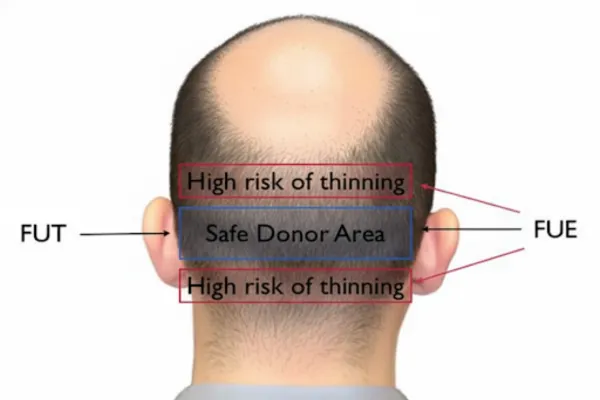
Having a limited donor area is one of the most common concerns among people considering a hair transplant. Many patients worry that not having “enough hair at the back” automatically rules them out for treatment. In reality, a limited donor area does not always mean a hair transplant is impossible, but it does mean the choice of method and planning become especially important.
This guide explains what a limited donor area means, which hair transplant methods may be more suitable, and how specialists approach these cases safely and realistically.
What Does “Limited Donor Area” Mean?
The donor area usually refers to the hair at the back and sides of the scalp that is genetically more resistant to hair loss. A donor area may be considered limited if:
- Hair density is naturally low
- Hair shafts are very fine
- Significant grafts have already been taken in a previous transplant
- Hair loss has progressed extensively
- There is scarring in the donor area
In these situations, every graft matters. The focus shifts from maximum coverage to strategic, conservative use of available donor hair.
Why Method Choice Matters More With a Limited Donor Area
When donor hair is limited, the main goals are to:
- Avoid over-harvesting
- Preserve the natural appearance of the donor area
- Achieve the best visual improvement with fewer grafts
- Keep future options open
Poor technique or aggressive harvesting can leave the donor area thin, patchy, or visibly scarred. Understanding how donor scarring and healing affect long-term results helps explain why careful method selection is essential in these cases.
FUE vs FUT: Which Is More Suitable With Limited Donor Hair?
FUE (Follicular Unit Extraction)
FUE involves removing individual follicular units from across the donor area.
Potential advantages for limited donor areas:
- No single linear scar
- Grafts can be harvested selectively from wider zones
- Greater control over extraction density and spacing
Important considerations:
- Over-harvesting is still possible without careful planning
- Donor density must be assessed thoroughly
- Surgeon experience is critical
For many patients with limited donor supply, carefully planned FUE is often preferred because it allows controlled harvesting while preserving donor appearance.
FUT (Follicular Unit Transplantation)
FUT involves removing a narrow strip of scalp from the donor area.
Potential advantages:
- Can provide a higher number of grafts in one session
- Surrounding donor hair remains untouched
Limitations with limited donor areas:
- Leaves a linear scar
- Less flexible when donor density is already low
- Not ideal for patients who prefer very short hairstyles
In patients with limited donor hair, FUT may be considered only in select cases and requires careful discussion about scarring and long-term donor appearance.
Advanced FUE Planning for Limited Donor Areas
Modern hair transplantation focuses less on the technique alone and more on how responsibly it is applied.
With limited donor hair, surgeons may:
- Use smaller extraction tools
- Spread harvesting across a wider safe zone
- Reduce graft targets to protect donor health
- Prioritise areas with the greatest visual impact, such as the frontal hairline
This conservative approach helps maintain a natural donor appearance and protects future treatment options.
Are Non-Scalp Donor Areas an Option?
Body Hair Transplant (BHT)
In selected cases, hair from areas such as the beard or chest may be used to supplement scalp donor hair.
Important points to understand:
- Body hair behaves differently from scalp hair
- Growth patterns and texture may not match
- Results are less predictable
BHT is usually considered a supportive or corrective option, not a primary solution for most patients.
What About Non-Surgical or Combined Approaches?
When donor hair is limited, surgery may not be the only or best first step.
Specialists may recommend:
- Medical treatments to slow ongoing hair loss
- Partial restoration rather than full coverage
- Staged procedures over time
- In some cases, delaying surgery altogether
Sometimes, doing less produces better long-term results.
What Specialists Look For Before Recommending a Method
A responsible assessment includes:
- Donor density and hair shaft thickness
- Hair loss pattern and stability
- Previous procedures and existing scarring
- Hairstyle preferences and expectations
This evaluation helps determine not just which method is possible, but whether surgery is advisable at all. Understanding how doctors assess whether someone is a good candidate for a hair transplant is especially important for patients with limited donor supply.
Clinics like Capilclinic, which work with many international patients from the UK and Europe, often focus on conservative planning rather than maximising graft numbers in these cases.
When Is a Hair Transplant Not Advisable?
A transplant may not be recommended if:
- Donor density is extremely low
- Hair loss is still rapidly progressing
- Expectations exceed what the donor area can safely support
Honest guidance at this stage helps prevent poor outcomes and long-term regret.
Final Thoughts
For someone with a limited donor area, there is no single “best” method that suits everyone. However, carefully planned FUE, sometimes combined with medical treatment or staged approaches, is often the safest and most suitable option.
Success depends less on the technique itself and more on responsible donor management, realistic goals, and long-term thinking.
If you’re concerned about a limited donor area and unsure which approach may suit you, the medical team at Capilclinic can assess your donor supply and guide you through your safest and most realistic options.
Medical Disclaimer: This article is for informational purposes only and does not replace professional medical advice, diagnosis, or treatment. Hair transplant suitability and outcomes vary between individuals. Always seek evaluation from a qualified medical professional before making treatment decisions.
At Capilclinic, we’re trusted by thousands of patients in the UK and Europe as a leading Hair Transplant Clinic in Turkey and Spain, known for our expert doctors, advanced facilities, natural hairline results, and affordable all-inclusive packages. Reach out to our team today to start your transformation.