



NHS advice: If you’re in the UK, check the clinic is registered with the Care Quality Commission (CQC), and make sure your doctor is licensed with the General Medical Council (GMC). The NHS also suggests checking BAHRS membership and asking clear questions like how many procedures they’ve done, complications, follow-up, and why a particular technique is recommended for you. Hair transplants are usually done under local anaesthetic as a day procedure, using either FUT (strip) or FUE (individual grafts).
Chapter 1 (Days 0–14)
Right after surgery, you’ll go home with instructions, often including a recovery spray. Take time off, slow down, and let the grafts “settle.”
- 1–2 weeks off work is commonly advised. Be very careful with transplanted hair for the first two weeks — the grafts are not secure. You may be told to reduce vigorous exercise for the first month to avoid scarring.
- Bandage: usually removed after 2–5 days; do not touch the grafts. Washing: by day 6, you can usually wash gently by hand. Stitches (FUT): non-dissolvable stitches are commonly removed 10–14 days after.
- What you might feel: a tight, achy, swollen scalp for a few days, and temporary scabbing. Scars differ by technique (a single line with FUT or many tiny dots with FUE).
Avoid bumping, rubbing, or overheating the scalp; follow your surgeon’s instructions to the letter.
Chapter 2 (Weeks 3–8)
Around a few weeks after surgery, the transplanted hairs often fall out. This is normal “shedding” and part of the hair cycle; the follicles remain in place and will re-enter a growth phase. Don’t chase quick fixes here — patience is the treatment.
Chapter 3 (Months 3–6)
This is when morale starts to pick up.
- Month 3–4: tiny, lighter hairs begin to appear (they can look wispy at first). As per NHS, new hair usually starts to appear by about 4 months.
- Month 5–6: Many people notice a real change now, with around 60% of final density visible by six months (everyone varies, but the uptick is common).
Stay consistent with sensible habits; don’t judge the outcome too early.
Chapter 4 (Months 7–10)
Hairs mature, get stronger, and start to blend. Styling gets easier, and the look becomes more uniform. Steady thickening and more natural styling freedom by months 9–10.
Chapter 5 (Month 12)
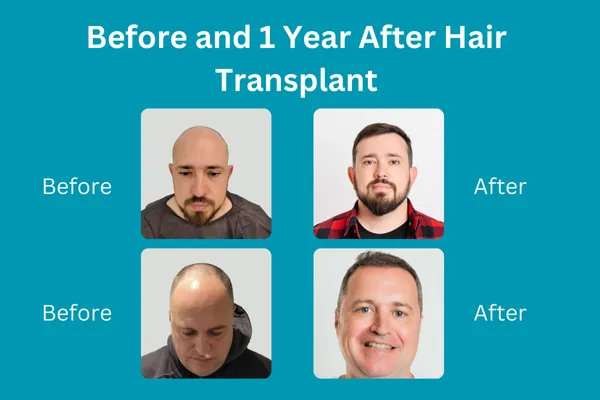
At the one-year mark, many people feel “finished”: coverage, texture, and movement look natural and integrated with native hair. This is the stage when density and texture feel final for most patients.
A useful nuance: As per NHS, full results can take 10–18 months, especially in slower-maturing areas like the crown. So don’t be surprised if things keep refining beyond the one-year selfie.
What’s normal and what needs attention
Normal:
Tightness, mild swelling, temporary scabbing; one linear scar (FUT) or many tiny dot scars (FUE). Early shedding after a few weeks and first visible regrowth around 4 months are expected.
Red flags:
Severe pain, bleeding, signs of infection, or unexpected symptoms — contact your clinic promptly. If you’re unhappy with results or care, speak with your surgeon; in England you can also contact the CQC or raise a concern with the GMC.
If you’re worried about shedding:
Some shedding is normal early on, but persistent, heavy shedding beyond ~6 months deserves a professional review.
Care that actually helps (simple, practical, realistic)
First month
- Treat grafts gently in the first 2 weeks; follow clinic instructions exactly.
- Bandage off 2–5 days, wash by hand from day 6, limit strenuous exercise for the first month, and plan 1–2 weeks off work.
Months 1–3
Minimise scrubbing, tight hairstyles, harsh chemicals, and high-heat tools; protect from strong sun in the early months; keep hydration and nutrition on point (protein plus iron, zinc, and biotin-rich foods). If your clinician prescribed medications or topicals, use them consistently.
Months 4–12
Keep regular follow-ups and photo updates with your clinic; resume exercise gradually; style gently at first as shafts thicken.
Frequently asked questions
Will I look odd in the first weeks?
You’ll have scabs and redness that fade. Plan low-key time while things settle. Expect a tight or achy scalp for a few days.
Why did my new hair fall out?
Because the shafts shed while follicles reset. It’s normal a few weeks after surgery, and new hair typically appears by ~4 months.
Is one year really “final”?
For many, yes — the one-year point is the stage of natural texture and movement.
What if I’m unhappy?
Speak to your surgeon and explain the results; they would be the best guide.
Conclusion
A hair transplant doesn’t change you overnight. It heals (two weeks), it rests (weeks 3–8), it starts (months 3–4), it builds (months 5–10), and it settles (around a year, sometimes up to 18 months). If you protect the grafts early and keep calm during the shedding phase, you give yourself the best chance of the result you pictured when you booked.
Medical note: this article is general education, not personal medical advice. Always follow your own surgeon’s instructions.
At Capilclinic, we’re trusted by thousands of patients in the UK and Europe as a leading Hair Transplant Clinic in Turkey and Spain, known for our expert doctors, advanced facilities, natural hairline results, and affordable all-inclusive packages. Reach out to our team today to start your transformation.