



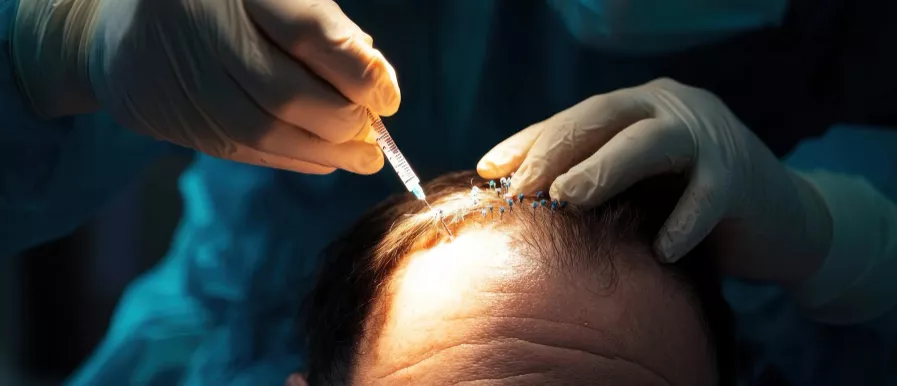
A hair transplant graft is the real unit that shapes the final result of a transplant. When patients talk about density, coverage, or a natural-looking hairline, they are usually talking about the visible outcome of how each hair transplant graft was selected, handled, and placed. That is why grafts matter so much. The success of a procedure is not decided by the headline number on a clinic brochure alone. It depends on the quality of the grafts, the safety of the donor area, the characteristics of the hair, and the long-term planning behind the surgery. Modern hair restoration is built around follicular units because they produce a more natural appearance than older plug-style approaches.
Many patients go into a consultation asking only one thing: “How many grafts do I need?” It is a fair question, but it is also incomplete. A graft count matters, of course, yet graft count without context can be misleading. Two people can receive the same number of grafts and walk away with very different-looking results because hair caliber, curl, contrast, donor density, and graft survival all influence how full the transplant appears. In other words, the importance of grafts in hair transplant surgery is not just about quantity. It is about what those grafts are, where they came from, and how intelligently they are used.
What Is a Graft in Hair Transplant Surgery?
In modern hair restoration, a graft usually refers to a follicular unit or a harvested hair bundle that contains naturally grouped hairs. In FUE, those follicular units are removed one by one, and they commonly contain one to four hairs. In FUT, a strip of donor tissue is removed and then dissected into individual grafts for placement. Either way, the graft is the building block of the transplant. It is the small biological package that ultimately determines how the hairline, mid-scalp, and crown will look after healing and growth.
This is where many people get confused. A graft is not the same thing as a single hair. Because one graft may contain more than one hair, a procedure involving 2,000 grafts does not mean 2,000 hairs. It may represent far more actual hairs, depending on the composition of those grafts. That distinction is important because surgeons do not plan only by counting grafts. They also think about how many hairs are inside those grafts, what type of grafts are needed in different zones, and how much visual coverage those grafts can create once they grow.
Why Graft Count Is Often Misunderstood
The reason graft count gets so much attention is simple: it is easy to market. Numbers feel concrete. Patients naturally assume that a higher graft count must mean a better transplant. But donor hair is limited, and reputable planning starts with that reality. It also warns that harvesting too broadly or too aggressively can compromise the long-term result. That means “more” is not automatically “better.” Sometimes it simply means riskier.
A skilled surgeon does not begin with the question, “How many grafts can I sell?” The better question is, “How many grafts can I safely remove and where will they make the biggest aesthetic difference?” That is why frontal restoration is often prioritized over trying to fill every weak area at once. Clinical guidance notes that patients correcting the frontal scalp usually achieve the most dramatic and lasting improvement, while using too many grafts in the crown too early can waste a limited donor supply and age poorly as future hair loss progresses.
The Importance of Graft Quality
A good graft is not just a graft that exists. It is a graft that survives. Research and clinical reviews on graft survival make it clear that the stresses placed on follicles during harvesting, storage, and implantation matter. Atraumatic handling, minimizing unnecessary time outside the body, and protecting the graft from mechanical and environmental stress all influence whether the follicle will grow well after surgery. One review specifically focuses on the many stresses that affect graft growth and survival, and another notes that graft survivability changes with handling conditions and out-of-body time.
This is also why transection matters. If follicles are damaged during extraction, the headline graft number becomes less meaningful because not every harvested unit will perform equally well. Modern guidance for FUE stresses the importance of low transection rates, atraumatic removal, and careful placement into appropriate recipient sites. In practical terms, patients should care less about how dramatic the graft number sounds and more about whether those grafts are intact, viable, and treated with precision throughout the procedure.
Why Donor Area Planning Matters
Every hair transplant lives and dies by donor management. The donor area is not an unlimited reservoir. If grafts are harvested outside safer boundaries, especially in younger patients or in people with progressing hair loss, those grafts may not remain permanent in the long run. So the importance of grafts is not only about how many are taken, but whether they were taken from the right place.
Donor planning also protects the back and sides of the scalp from visible thinning. The same guideline also explains that even broader removal limits depend on variables such as hairs per follicular unit, shaft diameter, curl, color, and angle of emergence. In plain language, one person may tolerate a certain graft count beautifully, while another may look visibly thinned in the donor area after the same number.
Grafts and Natural-Looking Density
One of the biggest myths in hair restoration is that density is created by numbers alone. In reality, the eye reads density as an illusion. Hair shaft thickness, curl, color contrast between hair and scalp, and the distribution of grafts all affect how full the result appears. Clinical sources note that thicker-caliber hair creates greater surface coverage and that lighter hair with less scalp contrast may appear fuller even with fewer grafts. That is why two cases with similar graft counts can look completely different after growth.
Naturalness matters just as much as density. Contemporary hair transplantation moved away from older plug techniques precisely because follicular unit grafting creates a softer, more believable result. More recent complication literature also points out that multi-hair grafts placed improperly in the frontal edge can create an unnatural, pluggy hairline. That means graft selection is artistic as well as technical. In practice, surgeons must think carefully about what type of graft belongs in each zone so the result frames the face naturally instead of looking heavy, abrupt, or obviously surgical.
More Grafts Are Not Always Better
Patients often assume that if 2,500 grafts are good, 4,000 must be better. The problem is that hair transplantation is a resource-management procedure. The donor area has limits, future loss may continue, and the scalp must still look good from every angle after surgery. Some practice guidelines also describe an average upper range of about 2,500 to 3,000 grafts per session as a practical limit to avoid visible donor depletion in many cases, though that number still depends on the individual scalp.
This is why the right graft strategy often looks conservative at first. A strong transplant is not the one that uses the most grafts on day one. It is the one that leaves the patient with a believable hairline, decent coverage, and enough donor reserve for the future if it is ever needed. Good surgeons think in years, not in before-and-after photos taken at month twelve. They plan for progression, not just for immediate impact. That long view is exactly what makes graft planning so important.
FUE and FUT: Different Harvesting Methods, Same Graft Logic
FUE and FUT are the two major ways of obtaining grafts, but the principle behind graft importance stays the same in both. FUE removes individual follicular units directly from the donor area, while FUT removes a strip that is then dissected into grafts. The harvesting method changes, the scar pattern changes, and the logistics change, but neither method cancels the need for strong donor evaluation, good graft handling, and intelligent placement. In both approaches, the final aesthetic result still depends on the quality and strategy of the grafts themselves.
That is also why patients should not frame the consultation as a simple FUE-versus-FUT popularity contest. The more useful question is which method protects donor resources best for that particular scalp and that particular pattern of loss. In some patients, FUE is an excellent fit. In others, FUT may still have advantages for yield or donor management. What matters is not the trendiest label, but whether the chosen method supports strong graft quality and a sustainable long-term plan.
What Patients Should Really Ask About Grafts
When discussing grafts with a surgeon, the smartest questions are usually not the flashiest ones. Patients should ask whether the donor area is strong, whether the pattern of hair loss is stable, whether the grafts will come from the safe donor zone, and how the clinic decides where different graft types should be placed. They should also ask about scalp health, donor density, hair caliber, and what level of coverage is realistically achievable rather than chasing a fantasy of full teenage density. These are the questions that actually determine whether grafts will create a result that still looks good years later.
Patients should also remember that grafts are not just biological units. They are limited assets. Once they are used poorly, they cannot simply be reset and spent again. That is why experienced organizations continue to stress physician-led planning, donor safety, and careful harvesting. The real importance of grafts in hair transplant surgery is that they are the currency of the whole procedure. Use them well, and the result can look natural and age gracefully. Use them carelessly, and even a high graft count can become a long-term disappointment.
Frequently Asked Questions
Does a higher graft number always mean a better result?
- No. A higher graft number can help in the right patient, but only if the donor area can support it safely without visible depletion.
- Graft count must be interpreted alongside donor density, hair caliber, curl, color contrast, and future hair-loss risk.
- In many cases, a smarter distribution of grafts creates a better-looking result than simply chasing the biggest number possible.
What affects graft survival the most?
- Gentle harvesting and low transection rates are essential, because damaged grafts are less likely to perform well after transplantation.
- Careful handling, protection from excessive stress, and minimizing unnecessary out-of-body exposure help preserve graft viability.
- Taking grafts from the safe donor zone also matters, because poorly selected grafts may not remain stable over time.
Can fine hair still look good with fewer grafts?
Yes, but it depends on the whole case. Fine hair usually provides less surface coverage than thicker hair, so it may require more careful distribution to create the same visual fullness. At the same time, reduced hair-to-scalp contrast can help some patients look better even when the graft count is modest. This is why experienced surgeons talk about the illusion of density rather than promising a simple numeric formula.
Is the crown more demanding than the front?
Often, yes. Clinical guidance notes that frontal restoration usually gives the most dramatic and durable aesthetic return, while treating the crown too aggressively can consume donor supply and become harder to maintain if hair loss progresses. That does not mean the crown should never be treated. It means graft planning has to be especially disciplined there, because the crown can absorb a large number of grafts without always delivering the same visible impact as the front.