



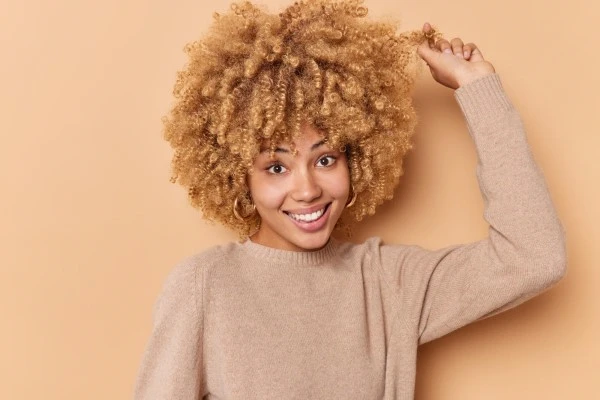
The fascinating realm of hair encompasses a multitude of distinctive features and qualities that define an individual’s personal mane. It all boils down to the intricate interplay of several factors, including the shape of the hair follicles, the thickness of individual strands, and the overall texture of the hair itself. The profound wisdom lies in unraveling the enigma of your hair type, as it serves as the guiding compass in selecting the perfect hair care products and styling methodologies tailored exclusively to meet your specific needs.
In this vast tapestry of hair diversity, we encounter four primary hair types, each adorned with its own enchanting subcategories:
The Sleek Symphony of Straight Hair: This hair type effortlessly glides with a velvety smoothness, devoid of any noticeable curls or waves. Resplendent in its glory, it possesses a captivating radiance, deftly reflecting light with utmost grace.
The Wondrous Cascade of Wavy Hair: Like a whimsical dance, wavy hair elegantly weaves an intricate “S” or “C” shape, exhibiting a gentle bend or wave. It does not conform to the straightness of type 1 hair, yet it doesn’t fully embrace the vivacious curls of type 3 or 4 hair.
The Spiraling Marvel of Curly Hair: Curly hair unveils a mesmerizing spectacle of tight, well-defined curls or coils, resembling a celestial symphony of captivating patterns. From loose, exuberant curls reminiscent of sidewalk chalk, to vivacious, springy coils akin to a marker or pen, and finally, to the intricate, corkscrew-like spirals that mimic the circumference of a pencil or straw, this hair type showcases a vibrant tapestry of delightful twists.
The Resilient Majesty of Coily/Kinky Hair: Embodied within the intricate labyrinth of coily or kinky hair lies a testament to resilience. With tightly coiled or zigzag-shaped strands, this hair type proudly embraces its unique essence. Beware the illusion of length, for shrinkage may cause it to appear shorter than its true magnificence when stretched. Witness the symphony of S-shaped coils, akin to a crochet needle; the exuberant Z-shaped coils, reminiscent of a pen spring; and the majestic, densely packed coils resembling a regular sewing needle.
You may also be interested: Premature Alopecia, what is it?
How To Style Each Types Of Hair
Each hair type requires unique styling techniques to enhance its natural beauty. Here are some general tips for styling different hair types:
Type 1: Straight Hair
- For added volume and texture, use a volumizing mousse or a texturizing spray before blow-drying.
- Create loose waves or curls using a curling iron or hot rollers for a change in style.
- Consider a sleek, straight look by using a flat iron to achieve a smooth finish.
- Experiment with different partings to add versatility and interest to your straight hair.
Type 2: Wavy Hair
- Embrace the natural texture by scrunching your hair with a lightweight curl-enhancing mousse or gel.
- Use a diffuser attachment on your blow dryer to enhance and define your waves.
- Opt for braids or twists while your hair is damp to create soft, beachy waves when you take them out.
- Experiment with different updos that incorporate the natural waves for a stylish and effortless look.
Type 3: Curly Hair
- Apply a curl-defining cream or leave-in conditioner to damp hair to enhance and define your curls.
- Avoid brushing or combing your curls when dry to prevent frizz. Instead, use your fingers or a wide-toothed comb while they’re wet.
- Try the pineapple method: Gather your curls at the top of your head in a loose ponytail or bun while you sleep to preserve their shape and prevent flattening.
- Consider protective hairstyles like braids, twists, or buns to protect your curls while adding a stylish flair.
Type 4: Coily Hair
- Keep your hair moisturized by using leave-in conditioners, oils, or creams specifically formulated for coily hair.
- Use the shingling method: Apply a generous amount of leave-in conditioner or curling cream to small sections of wet hair, smoothing it down with your fingers or a comb to define each coil.
- Experiment with twist-outs or braid-outs by twisting or braiding damp hair and unraveling them once dry for beautiful, defined coils.
- Rock afros or frohawks by picking out your hair at the roots with a wide-toothed comb or pick for maximum volume.
General Hair Care Tips
Proper hair care is crucial for maintaining healthy, vibrant hair. Regardless of your hair type, here are some detailed tips to keep your locks looking their best:
Regular Washing:
- Choose a shampoo and conditioner suitable for your hair type and specific needs (e.g., moisturizing, volumizing, color-safe).
- Wet your hair thoroughly with lukewarm water before applying shampoo. Massage it into your scalp, working your way down to the ends.
- Rinse your hair thoroughly to remove all shampoo residue.
- Apply conditioner to the lengths and ends of your hair, avoiding the scalp. Leave it on for the recommended time before rinsing thoroughly.
Proper Conditioning:
- Consider using a deep conditioner or hair mask once a week to provide extra nourishment.
- Apply the deep conditioner or mask to damp hair, focusing on the ends and damaged areas. Leave it on for the specified time before rinsing thoroughly.
- Use a wide-toothed comb or your fingers to detangle your hair gently while the conditioner is still in to avoid breakage.
Protection from Heat Styling:
- Limit the use of heat styling tools (such as flat irons, curling irons, and blow dryers) to prevent damage.
- Before using heat tools, apply a heat protectant spray or serum to shield your hair from high temperatures.
- Opt for lower heat settings and avoid leaving the tools in one area for too long.
Minimizing Damage:
- Avoid brushing wet hair, as it is more susceptible to breakage. Instead, use a wide-toothed comb or a brush specifically designed for wet hair.
- Be gentle when detangling your hair, starting from the ends and working your way up.
- Use hair elastics without metal components to prevent snagging and breakage.
- Consider protective styles like braids, buns, or twists to minimize daily manipulation and friction.
Moisture and Hydration:
- Keep your hair hydrated by using leave-in conditioners, hair oils, or serums to lock in moisture.
- Limit exposure to harsh environmental conditions, such as excessive sun, wind, or chlorine from swimming pools, which can dry out your hair.
Cover your hair with a hat or scarf when exposed to the sun for extended periods.