



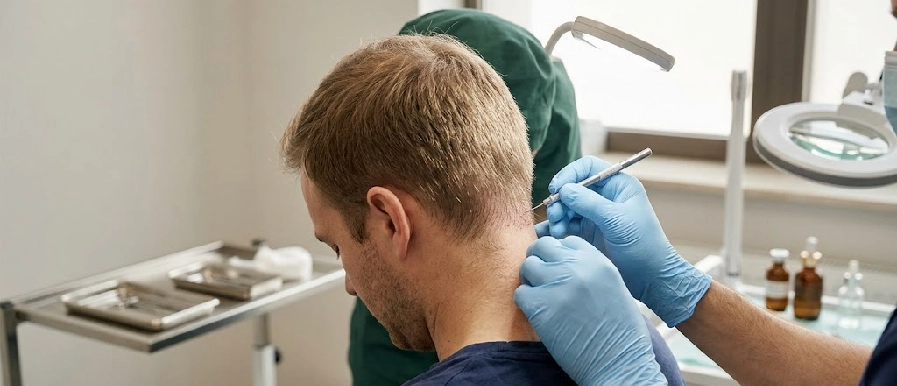
Yes, you may be able to get a hair transplant with a weak donor area, but not every patient is suitable. Eligibility depends on donor density, hair thickness, follicle stability, the size of the balding area, previous surgery, and your expectations.
A hair transplant does not create new follicles. It redistributes a limited supply of existing hair from a donor region—usually the back and sides of the scalp—to thinning or bald areas. Donor quality is therefore one of the most important factors in determining whether surgery is safe and whether the result will remain natural.
Patients with mildly reduced density may still improve through conservative planning. Severe thinning, widespread miniaturization, or an unstable donor zone may make transplantation unsuitable. A hair restoration physician should examine the scalp before recommending surgery or alternatives.
Careful assessment matters more than choosing the most popular technique.
What Is the Donor Area?
The donor area is the region from which healthy follicular units are harvested. Hair at the back and sides of the scalp is commonly used because it is often more resistant to the hormonal effects associated with pattern hair loss.
A strong donor area has adequate density, thick shafts, limited miniaturization, good scalp health, and enough remaining hair to conceal scars.
The Cleveland Clinic explains that good candidates generally need thicker areas of naturally growing hair to serve as donor sites. Patients without enough healthy donor hair may not be ideal candidates for surgery.
What Does a Weak Donor Area Mean?
A weak donor area may have low density, fine hair, extensive miniaturization, scarring, a narrow safe zone, or damage from previous overharvesting. Warning signs include visible scalp under normal lighting, uneven density after FUE, or thinning at the back and sides.
Some clinical references describe densities below approximately 40 follicular units per square centimetre as less suitable, while densities above 80 may be considered excellent. However, density is not the only factor. Hair calibre, curl, colour contrast, graft composition, and recipient-area size also affect the visual result.
Can a Hair Transplant Work With Low Donor Density?
Yes, if the donor follicles are stable and the plan is conservative. A patient may not have enough grafts to restore the entire scalp at high density but may still benefit from improving the frontal hairline and forelock.
The front usually has the greatest visual impact. A higher, age-appropriate hairline and lighter crown coverage can make limited grafts more effective.
A limited-donor plan may treat a smaller area, preserve follicles for future loss, and avoid aggressive sessions. It cannot usually recreate adolescent density across a large bald scalp; the goal is better framing and the illusion of coverage.
When Is the Donor Area Too Weak?
A transplant may be inappropriate when the donor region is affected by active or progressive hair loss. This can occur in diffuse unpatterned alopecia, or DUPA, where miniaturization extends into areas normally considered permanent.
Hair taken from an unstable zone may continue to thin after transplantation. Surgery may also leave the donor visibly depleted while producing insufficient coverage. Clinical guidance identifies DUPA as a contraindication or relative contraindication because a stable donor source may not exist.
Other reasons to delay or avoid surgery include active scarring alopecia, unstable alopecia areata, rapid progression, severe scarring, previous overharvesting, or unrealistic expectations.
How Is Donor Strength Evaluated?
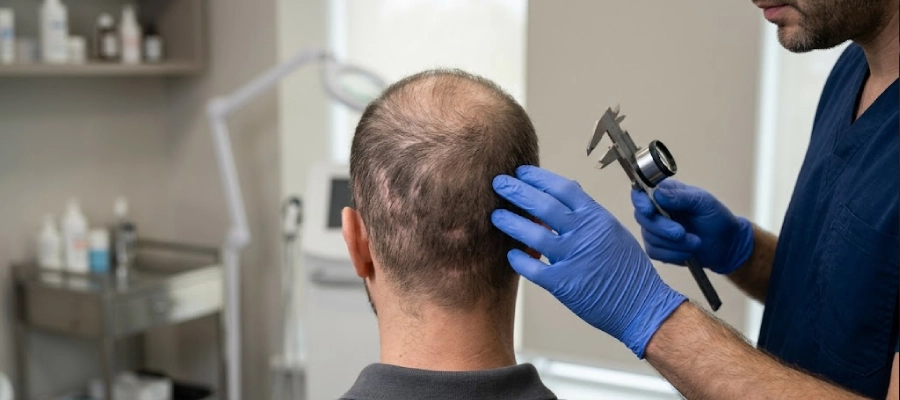
A reliable consultation may use magnification, trichoscopy, and density measurements at several points.
The assessment covers density, hair calibre, hairs per follicular unit, miniaturization, curl, colour contrast, previous extraction patterns, scars, and remaining coverage.
Donor Density
Donor density refers to the number of follicular units within a measured area of the scalp. It should be assessed in several locations because density may vary across the back and sides of the head.
Hair Calibre
Thicker hair shafts provide greater visual coverage than fine hairs. Two patients receiving the same number of grafts may therefore achieve very different levels of apparent density.
Follicular-Unit Composition
A follicular unit may contain one, two, three, or occasionally more hairs. Donor areas containing a higher proportion of multi-hair grafts may provide better visual coverage.
Follicular Miniaturization
Miniaturization occurs when follicles gradually produce thinner, shorter hairs. A high percentage of miniaturized hairs in the donor region may indicate that the follicles are not stable enough for transplantation.
Previous Hair Transplants
Patients who have already undergone FUE or FUT require a careful evaluation of their remaining donor supply. Extraction patterns, scarring, and reduced density can limit the safety of another procedure.
Is FUE or FUT Better for a Weak Donor Area?
Neither technique is automatically better. The right method depends on donor characteristics, hairstyle preferences, scarring risk, scalp laxity, previous operations, and the required graft number.
FUE
Follicular Unit Excision removes individual units with small punches. It avoids a linear scar, but every extracted graft permanently reduces donor density.
Excessive or uneven harvesting can create patchy, “moth-eaten” thinning. Medical literature identifies overharvesting as a cause of permanent donor damage.
FUE may still be appropriate for patients with slightly reduced density when a limited number of grafts is removed carefully and distributed evenly throughout the safe donor zone.
However, attempting to extract a very high number of grafts from a weak donor area can make the scalp appear thinner, especially when the hair is cut short.
FUT
Follicular Unit Transplantation removes a narrow strip of hair-bearing scalp, which is dissected into individual grafts.
FUT leaves a linear scar, but it may preserve the appearance of density outside the removed strip and provide useful graft numbers from a narrow, stable donor zone.
For selected patients, FUT or a carefully planned combination of FUT and FUE may help maximise lifetime graft availability. The decision should be made by a surgeon experienced in both methods.
Can Beard or Body Hair Be Used?
Beard hair may supplement scalp grafts, add density behind the hairline, or cover scars. Chest and other body hair can also be considered, but outcomes are less predictable.
Body hair differs from scalp hair in texture, maximum length, growth cycle, curl, and colour. Research reviews emphasise that it may not fully match scalp hair and must be selected carefully.
Body hair is a supplementary resource, not a guaranteed replacement for a poor scalp donor area. Fine scalp grafts are generally preferred for a soft, natural-looking hairline.
Coarser beard grafts are usually more suitable for the middle of the scalp, crown, or areas behind the frontal hairline. Placing thick beard hairs directly at the front may create an unnatural appearance.
Not every patient has suitable beard or body hair. The surgeon must evaluate hair thickness, colour, curl, growth length, and extraction safety before including these grafts in the treatment plan.
Can Treatment Strengthen a Weak Donor Area?
Medical treatment may improve miniaturized hair in some patients or stabilise ongoing loss. It cannot replace follicles that have been permanently lost or removed.
Depending on the diagnosis, a physician may discuss minoxidil or prescription anti-androgen therapy, which require professional guidance.
Patients with unstable loss may be advised to use medical therapy for six to twelve months before reconsidering surgery. Stabilisation can improve planning and reduce the risk of chasing progressive hair loss.
PRP or low-level light therapy may be supportive, but neither creates an unlimited donor supply or reverses severe depletion.
A patient should also be cautious of clinics claiming that a medication, supplement, or injection can completely restore an overharvested donor area. Once a follicle has been surgically removed, standard medical treatments cannot regenerate that follicle in its original position.
Risks of Using Insufficient Donor Hair
An aggressive transplant can create two cosmetic problems: poor recipient density and visible donor thinning.
Possible consequences include:
- Patchy or uneven donor depletion
- Noticeable FUE extraction scars
- A widened or visible FUT scar
- Poor recipient-area density
- An isolated or unnatural hairline
- Insufficient grafts for future procedures
- Continued thinning around transplanted hair
- Difficulty wearing short hairstyles
- Disappointment caused by unrealistic expectations
Donor follicles removed through FUE do not grow back in their original positions. Donor hair must therefore be managed as a finite, lifetime resource.
This is especially important for younger patients because their hair loss may continue for many years. Using too many grafts during an early procedure can leave too few follicles available when additional areas become thin.
How to Improve Your Chance of a Natural Result
Choose a physician-led clinic that performs a detailed diagnosis and is willing to say no when surgery is unlikely to help.
A responsible plan should explain your estimated graft supply, safe harvesting limits, future hair-loss risk, treatment alternatives, and priority areas.
Ask your surgeon the following questions:
- Is my donor hair stable or miniaturized?
- What is my measured donor density?
- How many grafts can be harvested safely?
- How many grafts should remain for future procedures?
- Why are you recommending FUE, FUT, or a combination?
- Is my beard hair suitable as an additional donor source?
- Which areas of my scalp should receive priority?
- How will my result look under bright light?
- Will the donor area remain presentable with short hair?
- What happens if my natural hair continues to thin?
Avoid clinics that promise maximum graft numbers without measuring the donor area or discussing long-term progression.
A trustworthy surgeon should focus on the long-term appearance of both the recipient and donor areas rather than simply extracting the highest possible number of grafts.
Frequently Asked Questions
Can I have a hair transplant if my donor area is thin?
Possibly. Thin donor hair may support a smaller transplant if the follicles are stable. Severe or progressive thinning can make surgery unsuitable.
How many grafts can be taken from a weak donor area?
There is no universal number. Safe availability depends on density, donor-zone size, hair calibre, graft composition, previous procedures, and the hair needed to conceal harvesting.
Does donor hair grow back after FUE?
No. Extracted follicular units do not regrow in their original locations. Surrounding hairs continue to grow and may conceal the extraction points.
Can beard hair compensate for poor scalp donor hair?
Beard grafts may supplement scalp hair for central density or scar coverage. They are usually not ideal as the only source for a soft frontal hairline because they are often coarser.
Is FUE safe for a low-density donor area?
It can be when extraction is conservative and evenly distributed. Aggressive FUE may cause visible, permanent thinning.
Is FUT better when donor hair is limited?
FUT may be useful for selected patients because it harvests grafts from a defined strip. It leaves a linear scar and is not suitable for everyone.
Can medication make a weak donor area suitable?
Medication may strengthen miniaturized hairs or stabilise ongoing loss in some patients. It cannot replace follicles that have been permanently removed or destroyed.
What are the alternatives if I am not a candidate?
Options include medically supervised treatment, scalp micropigmentation, cosmetic hair fibres, hairstyle changes, or a hair system.