



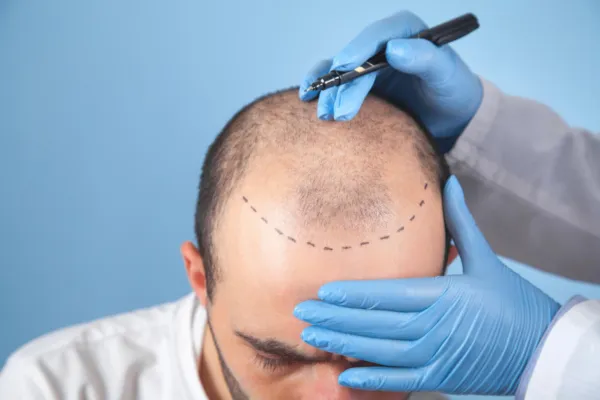
A great hairline isn’t a line, it’s a plan. The most convincing results happen when your surgeon balances facial proportions, anticipates future hair loss, respects donor limits, and places every graft at the right angle and direction. Below is a behind-the-curtain look at how natural hairlines are designed, why temple points matter so much, and how tools like FUE and DHI influence angle control in the crucial front 1–2 cm.
1) What “natural” really means
“Natural” doesn’t mean “lowest” or “densest.” It means:
- Face-fit: The hairline frames your features in motion and at rest.
- Future-proof: It will still look right as your pattern matures.
- Donor-smart: It doesn’t burn through precious grafts you may need later.
Surgeons consider age, sex, ethnicity, forehead height, brow/eye position, hair caliber/texture/curl, and skin–hair color contrast. These variables determine the shape and softness of your edge, the density you can carry, and how light falls across the front.
2) Face balance and the millimeter game
Design begins with facial thirds and overall proportions, but individualized to you:
- Forehead height & contour: A subtly M-shaped male hairline with soft recessions at the corners almost always reads more natural than a low, flat “helmet.”
- Corner strategy: Corners are tapered and slightly recessed to avoid a boxed look.
- Ethnic patterns: Typical temple point location, hairline curvature, and feathering vary by ancestry; respecting these cues keeps results believable.
- Female vs male patterns: Female hairlines are flatter and a touch lower with softer, rounded corners.
A few millimeters too low can trap you later as loss progresses; a few millimeters too high can age the face. Good plans live in the sweet spot.
3) Zones of the hairline: transition, core, and forelock
Surgeons don’t “draw and fill.” They build zones:
- Transition (feathering) zone (~5–10 mm)
- Single-hair grafts only
- Broken, irregular outline (micro- and macro-irregularity)
- Low density that ramps up behind
- Core hairline
- Mix of 1/2/3-hair grafts for coverage and strength
- Density increases smoothly—no hard walls
- Forelock (central tuft)
- Slight density emphasis to “anchor” the look
- Calibrated so it still looks natural as you age
Your eye reads edges first. If the first few millimeters are soft and random with true singles, everything behind them looks more natural—even at moderate densities.
4) Angles, direction, curl: the language of hair
Even perfect density looks fake with wrong angles. Site-making dictates:
- Low exit angles in the front (often 10–15°), increasing gradually toward mid-scalp.
- Directional flow: Forward in the center; laterally and slightly backward toward the corners; very low and posterior-swept at the temple points.
- Curl & caliber: Coarse, curly hair casts more shadow (needs fewer grafts for a “full” read) but demands delicate feathering to avoid a blunt edge. Fine, straight hair needs meticulous singles and heavier micro-irregularity.
5) Temple points: small triangles, huge impact
The temple points (triangular tufts in front of each ear) frame the face:
- They narrow the upper face, balance a mature hairline, and make the front look stronger without lowering it.
- They require very acute angles (low to the skin) and almost exclusively single-hair placement.
- Overbuilt temple points look artificial or feminizing in men. When donor supply is tight, they can be staged later.
If you’re researching a hair transplant clinic in Turkey, ask to see macro close-ups of temple points in patients with your hair type—this is where artistry shows.
6) Density planning: numbers that serve the illusion
Think by zones, not averages:
- Feathering zone: ~20–30 FU/cm², singles only
- Core frontal zone: ~40–55 FU/cm² (adjusted to hair caliber/contrast)
- Forelock highlight: modest bump if donor allows
- Crown: intentionally lower target to conserve grafts
The illusion of fullness comes from caliber, curl, contrast, layering, and angle—not just big numbers. A well-angled 45 FU/cm² can look fuller than a poorly angled 60 FU/cm².
7) Designing for the future (age-appropriate plans)
A hairline that’s perfect at 25 can look wrong at 40 if it’s too low or too straight. Responsible plans:
- Forecast likely progression (family history, miniaturization mapping).
- Preserve donor for later (mid-scalp/crown refinements).
- Pair surgery with medical maintenance (e.g., minoxidil; and for eligible men, finasteride) to protect native hair.
Natural results are conservative up front and flexible later.
8) Technique supports design: FUE, DHI, FUT
- FUE (including DHI/Sapphire variants) is favored for tiny dot scarring and angle flexibility—great for feathered edges and temple points.
- FUT (strip) can still be right for certain donor situations and large cases.
- Tooling (blades, needles, implanter pens) matters less than who’s holding it and how the team controls angle/direction/depth.
A seasoned hair transplant surgeon in Turkey should explain why a technique or tool fits your hair and goals, not just what’s fashionable.
9) Special scenarios: female hairlines, lowering, and repair
- Female hairlines: flatter, lower, with rounded corners and softer temple areas; density and feathering differ from male patterns.
- Hairline lowering/forehead reduction: can be combined with grafting to soften edges and maintain natural irregularity.
- Repair work: plug camouflage/removal, scar revision, and re-angulation of misdirected grafts; sometimes removing and re-placing old grafts is better than piling on new ones.
10) Testing the design before a single graft
Expect a real-time mock-up:
- Pencil/marker outline with micro-breaks at the edge
- Angle tests that match your styling direction
- “Talk and turn” check: the design must look right in motion, not just on a still photo
- Multi-angle photos for intra-op reference and follow-ups
11) Donor ethics and lifetime math
Natural front + exhausted donor = bad trade. Ethical planning:
- Observe safe extraction limits and even spread.
- Track graft counts by caliber (singles/doubles/triples).
- Reserve a future budget for progression.
- Document everything you and your surgeon decide.
When you read Hair Transplant Turkey Reviews, look beyond headline graft numbers. Prioritize notes about angle realism, temple points, aftercare, and long-term follow-up.
Addendum: Angle Control—FUE vs DHI (What Changes in the Front 1–2 cm)
Why this matters: In the hairline and temple points, exit angles are extremely acute (often 10–15°). Tiny deviations change how light hits the edge and whether combing feels intuitive.
FUE with pre-made sites (blades/needles):
- The surgeon first creates recipient sites at chosen angles/directions, essentially “drawing” the flow with slits.
- This pass gives strong macro control of pattern (forelock forward, corners lateral/back, temples low and posterior).
- Techs place grafts into those slits; the challenge is guarding uniform depth and consistent low angles during mass placement.
DHI (implanter pens/Choi):
- Sites are created and grafts implanted in one motion.
- Many surgeons favor DHI at the very front and in temple points for fine-grained angle consistency and dense packing, especially with delicate singles.
- Trade-off: slower pace and operator fatigue in very large sessions—requires a tight, well-trained team.
Bottom line: Both approaches can deliver natural angles. The “right” choice depends on your hair caliber, skin elasticity, target density, and—most importantly—the surgeon’s mastery. When comparing a hair transplant clinic in Turkey, ask for close-ups of hairline edges and temple points, and how the team mixes tools (e.g., DHI pens for edges, blades for mid-scalp) to match your case.
What to ask at consultation
- How did you pick the height/shape of my hairline for my age and face?
- Show me the feathering plan (width in mm and number of single-hair grafts).
- What angles/directions in center, corners, and temple points?
- What density targets by zone—and what’s my lifetime donor budget?
- FUE vs DHI vs FUT: which tool where, and why?
- How will we protect donor for later (mid-scalp/crown)?
- What medical maintenance do you recommend to protect native hair?
- Can I see macro close-ups of results in patients with my hair type?
- What’s the aftercare and return-to-exercise timeline?
- If loss progresses, what’s Plan B that still looks natural?
FAQs
Do I need temple points reconstructed?
Not always. They’re powerful when recession there hurts face balance. Done lightly at very acute angles with singles, they can transform your frame; overbuilt temple points look unnatural.
Can I request a very low hairline?
You can, but a responsible surgeon will show why too low burns donor and can look odd with age. The most natural hairlines are age-appropriate and future-aware.
Will curly hair help?
Often yes. Curl and caliber add shadow and lift, so you may achieve a fuller read at lower numeric densities—provided angles respect your curl pattern.
When will it look “natural”?
Edges look convincing once scabs shed (~7–14 days). True fullness develops from months 3–6 and matures by ~12 months.
Final word
A natural hairline is the sum of face balance, feathered edges, precise angles, and donor math—executed by a team that can reproduce low, consistent angles in the most visible few centimeters. If you’re early in research, meet more than one provider and ask to see close-up photos, not just distant before/afters. And if you’re comparing options abroad, a reputable hair transplant clinic in Turkey should walk you through angle planning, temple point design, and donor strategy with transparency. Pair that due diligence with what you learn scanning Hair Transplant Turkey Reviews, especially comments about comfort, aftercare, and how results look up close in everyday light.
At Capilclinic, we’re trusted by thousands of patients in the UK and Europe as a leading Hair Transplant Clinic in Turkey and Spain, known for our expert doctors, advanced facilities, natural hairline results, and affordable all-inclusive packages. Reach out to our team today to start your transformation.