



The structure of hair is more intricate than it seems. Hair significantly impacts the appearance of both women and men. It also contributes to the transmission of sensory information and establishes gender identification. One million hair follicles are distributed around the head, with only a hundred thousand on the scalp. Humans do not produce new hair follicles at any point during their lives or hair growth phases. Therefore, this is the maximum number of follicles a person can ever have.
As people transition from infancy to adulthood, most will become aware of a decreased air density on their scalp. The reason for this is that the scalps enlarge as we get older. In this article, we will explain the four hair growth phases. We will also discuss the pros and cons of not following proper hair care. Taking care of your hair is essential for its health and appearance. Neglecting it can lead to various issues. Understanding these aspects is crucial for maintaining beautiful hair.
What are the Hair growth phases?
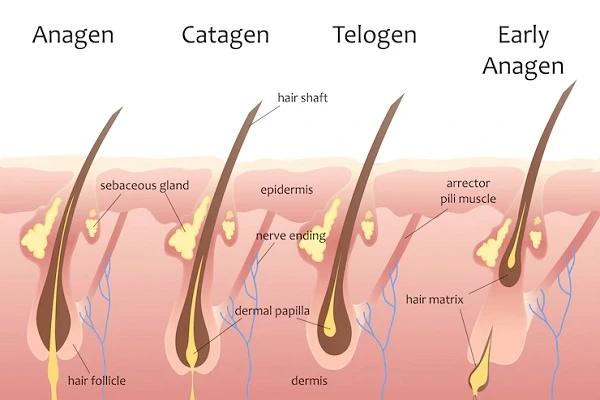
Hair grows on the scalp at an average rate of 0.3 to 0.4 millimeters per day. This translates to about 6 inches annually. Unlike many mammals, humans do not experience seasonal or cyclical hair growth and shedding. Instead, human hair growth does not follow such patterns. Each strand of hair on the scalp undergoes a complex process. This process involves four distinct phases: anagen, catagen, telogen, and exogen.
1. Anagen phase
The anagen phase is the active growth phase of the hair cycle. During this phase, cells in the hair root rapidly divide. These divisions push the hair shaft upwards and out of the follicle, resulting in visible hair growth. Hair grows about one centimeter every 28 days during the anagen phase. The duration of this phase can vary greatly from person to person. Typically, it lasts between 2 and 7 years.
The length of the anagen phase directly affects how long the hair can grow. People with shorter anagen phases may struggle to grow their hair beyond a certain size. In contrast, those with longer phases can achieve much longer hair. Hair on different parts of the body has a much shorter anagen phase. For example, hair on the arms, legs, eyebrows, and eyelashes lasts only 30 to 45 days. This difference explains why body hair is much shorter than scalp hair.
2. Catagen phase
The catagen phase is a brief yet significant transitional stage in the hair growth cycle. This phase lasts approximately 2 to 3 weeks. During this period, the hair ceases to grow. The root sheath surrounding the hair follicle begins to shrink. This shrinking process causes the root sheath to attach firmly to the hair root. As a result, what is known as “club hair” forms. At this stage, the hair follicle effectively becomes cut off from the nutrients provided by the blood supply. This change signals the halt of further growth.
Interestingly, only about 3% of hair follicles are in the catagen phase at any given moment. This statistic highlights its rarity among the various stages of hair growth. Despite its relatively short duration, this phase plays a vital role. It signifies the conclusion of active hair growth. Thus, it paves the way for the follicle to transition into the next phase of the growth cycle. The catagen phase serves as a crucial bridge. It prepares the hair for its eventual renewal and regeneration.
3. Telogen Phase

The telogen phase is often referred to as the “resting phase” of hair growth. This period lasts about 100 days for scalp hair. For body hair, the resting phase lasts much longer. During this time, the follicle remains dormant. Between 6% and 8% of all hairs are in the telogen phase at any given moment. While the follicle is dormant, the hair stays in place but does not grow.
At this stage, the hair bulb holds the hair strand in place. The bulb becomes dry and hard, resulting in the characteristic white bulb seen when a telogen hair is shed. On average, a person loses between 25 and 100 hairs per day during this phase. The shedding of telogen hairs is a normal part of the hair growth cycle. It is not usually a cause for concern unless the shedding becomes excessive.
4. Exogen phase
The exogen phase continues the telogen phase, although it has a distinct role as a shedding phase. During this phase, the hair strand separates from the follicle and eventually falls out. The exogen phase is crucial because it makes room for a new hair strand to start growing in the follicle. This process restarts the hair growth cycle.
This phase can last from a few days to a few weeks. Individual hairs shed at different times during this period. While some shedding is normal, excessive hair loss during the exogenous phase can indicate underlying problems. These problems may include stress, nutritional deficiencies, or medical conditions.
Consequences of interrupting the hair growth phases

Disrupting the natural progression of the hair growth cycle can have serious consequences for the health and appearance of your hair. Each phase of the cycle—anagen, catagen, telogen, and exogen—plays a crucial role in maintaining healthy hair. Not following these phases/after-care steps can lead to a range of problems, from stunted hair growth to excessive shedding.
Disrupting the Anagen phase
Interrupting this phase can severely limit your hair’s growth potential. Factors such as stress, poor diet, certain medications, or underlying medical conditions can cause this. If the anagen phase is interrupted, hair may grow much slower or stop growing altogether, resulting in short, stubby strands.
Interruption of the Catagen phase
The catagen phase is a transitional stage that prepares the hair follicle for the resting (telogen) phase. Interruptions in this phase can lead to excessive shedding, often caused by mechanical stress from tight hairstyles or aggressive hair care. Disruption prevents proper transition to the telogen phase, worsening the shedding issue.
Disrupting the Telogen phase
The telogen phase is the resting phase of hair follicles, during which hair strands are prepared to be shed. Disruptions in this phase can cause hair to stay in the follicle longer, leading to a build-up of dead hair, excessive shedding, and difficulty styling. Stress, hormonal changes, and certain medications can disrupt the telogen phase.
Interruption of the Exogen phase
Disrupting this phase can lead to a buildup of dead hair. It results in increased shedding and a thinner, less voluminous appearance. Several factors can cause this disruption. Over-manipulation of the hair can contribute to the issue. Frequent shampooing can also have an impact. Additionally, the use of harsh hair products can damage the hair and follicles.
How to keep your hair healthy during the Hair Growth phases

Having hair that is both healthier and fuller is dependent not only on your genes and hormone balances, which are primarily out of control but also on things that you can influence, such as a healthy lifestyle and taking care of the hair properly. The following are some of the most effective ways to maintain hair growth during all four phases:
Diet & nutrition
Maintain a regular diet that provides your body with adequate vitamins. Iron, fiber, and protein will also assist in regulating the hair growth cycle. You may want to consider adding supplements to your routine to exert additional control over your body.
Minimize stress
Heightened stress levels can significantly reduce the duration that hair spends in its resting phase, known as the telogen phase. This means that when stress is prevalent, hair may not stay in a state of rest long enough, leading to increased shedding.
By incorporating a variety of strategies to diminish and effectively manage stress, you can create a healthier environment for your hair, allowing it to thrive and potentially reducing the negative effects of stress on hair growth.
Use the appropriate products

If you have limp or thinning hair, targeted products are available that can significantly improve your situation. These carefully formulated solutions are designed to meet the unique needs of your hair, regardless of its current state or condition.
You can enhance your hair’s natural potential, promoting fullness and strength. You will also add vitality at every stage of its life cycle. Whether your hair is flat and lifeless or experiencing some thinning, these products work to rejuvenate and revitalize, allowing you to embrace your hair’s true beauty.
Faq’s
How long does the hair growth phases and cycle take?
The complete hair growth cycle, from the anagen phase to the telogen phase, takes approximately 2-7 years. During the first face, hair actively grows at a rate of about 0.3 to 0.4 millimeters per day. On the other hand, the last phase typically lasts around 3-4 months.
Conclusion
Understanding the intricate structure and phases of hair growth is essential for maintaining healthy and beautiful hair. From the active growth of the anagen phase to the transitional catagen phase, the resting telogen phase, and the shedding exogen phase, each stage plays a vital role in hair health. Disruptions in these phases can lead to a range of issues, including stunted growth and excessive shedding. However, by adopting a healthy lifestyle, managing stress, and using appropriate hair care products, individuals can support their hair through each phase of growth.