



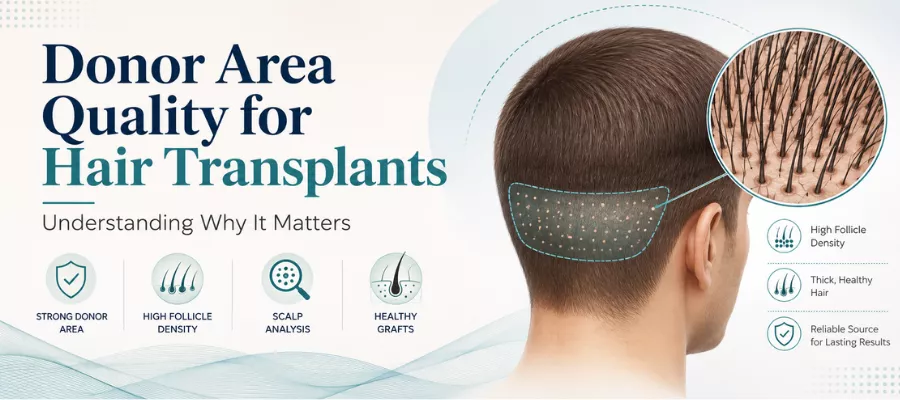
Donor area quality for hair transplants is one of the most important factors influencing whether a hair restoration procedure can produce natural-looking, long-lasting results. In simple terms, donor area quality for hair transplants refers to the strength, density, thickness, and overall health of the hair available for extraction, usually from the back and sides of the scalp. Even when the recipient area is suitable for transplantation, limited or weak donor hair can restrict what a surgeon is realistically able to achieve.
A strong donor area gives the medical team greater flexibility when planning graft numbers, hairline design, density, and future procedures. By contrast, poor donor area quality for hair transplants may require a more conservative approach. This is why experienced clinics assess the donor region carefully before recommending FUE, DHI, or another transplantation technique.
| Donor Area Feature | Why It Matters | Ideal Characteristic |
|---|---|---|
| Hair density | Determines how many grafts may be safely harvested | Moderate to high density |
| Hair thickness | Influences visual coverage after transplantation | Medium to thick strands |
| Follicular units | Affects the number of hairs obtained per graft | Healthy multi-hair grafts |
| Scalp condition | Can affect extraction and healing | Healthy, irritation-free scalp |
| Hair loss stability | Helps predict future donor availability | Stable pattern of hair loss |
Donor Area Quality for Hair Transplants: What Makes a Donor Area Strong?
A strong donor area is not defined by a single measurement. Specialists evaluating donor area quality for hair transplants look at several characteristics together, including follicular density, shaft thickness, hair texture, scalp elasticity, and the percentage of follicles that appear resistant to progressive hair loss. A patient may have a visibly dense donor area but still require careful assessment if the hair strands are unusually fine or if thinning extends into regions traditionally considered safe for harvesting.
Another important factor is the relationship between available grafts and the size of the area requiring restoration. Good donor area quality for hair transplants does not mean unlimited donor hair. Every scalp has a finite number of follicles that can be extracted without creating visible thinning. Proper planning therefore involves deciding not only what can be transplanted today, but also what should be preserved for the future.
| Assessment Factor | What the Specialist Evaluates | Potential Impact |
|---|---|---|
| Follicular density | Number of follicular units per area | Higher density may allow more grafts |
| Hair caliber | Thickness of individual strands | Thicker hair can provide stronger coverage |
| Hair texture | Straight, wavy, or curly structure | Wavy and curly hair may create greater visual density |
| Donor stability | Resistance to future thinning | Helps support long-term results |
| Previous extraction | Existing donor depletion or scarring | May reduce available graft numbers |
Donor Area Quality for Hair Transplants: Which Factors Affect Donor Strength?
Several characteristics can influence donor area quality for hair transplants, and each one should be considered before deciding how many grafts can be safely removed. A professional donor assessment is particularly important because visual appearance alone does not always reveal how suitable the follicles are for transplantation.
- Hair density: A higher number of follicles within the safe donor zone generally provides more options for harvesting.
- Hair shaft thickness: Thick strands usually create better visual coverage than very fine strands.
- Follicular unit composition: Grafts containing two, three, or more hairs can contribute significantly to density.
- Hair texture: Curly or wavy hair often provides greater coverage because each strand occupies more visual space.
- Scalp health: Conditions involving inflammation, irritation, or scarring can influence extraction planning.
- Previous procedures: Earlier hair transplants may reduce the remaining donor supply.
- Progressive hair loss: Continued thinning around the donor region can affect the long-term stability of transplanted grafts.
Donor Area Quality for Hair Transplants: Why Hair Density Is So Important
Density is one of the first measurements considered when evaluating donor area quality for hair transplants. The donor region must contain enough follicles to allow extraction while still maintaining a natural appearance after surgery. Removing too many grafts from a limited area can leave the back or sides of the scalp looking uneven, patchy, or visibly depleted.
The goal is therefore not to extract the highest possible number of grafts. A skilled surgeon aims to remove an appropriate number while protecting the appearance of the donor area. Good donor area quality for hair transplants allows grafts to be distributed across a wider extraction zone, which may make the procedure less noticeable once healing is complete.
Donor Area Quality for Hair Transplants: Does Hair Thickness Affect the Result?
Hair thickness can make a surprisingly large difference to the final appearance of a transplant. When assessing donor area quality for hair transplants, surgeons consider the diameter of the hair shaft because thicker strands cover more scalp than fine strands. Two patients receiving the same number of grafts may therefore achieve noticeably different visual density if one has significantly thicker hair.
Fine hair does not automatically make someone unsuitable for transplantation. It simply changes the planning process. In cases where donor area quality for hair transplants involves fine-caliber hair, graft placement, hairline design, and density expectations may need to be adjusted. Realistic planning often produces a better result than trying to create an appearance the donor supply cannot safely support.
Donor Area Quality for Hair Transplants: How Does Hair Texture Influence Coverage?
Hair texture is another factor that can affect donor area quality for hair transplants. Wavy and curly hair tends to create more visual volume because individual strands overlap and occupy more space. This can make the scalp appear better covered even when the total number of transplanted follicles is similar to that of a patient with very straight hair.
Straight hair can still create excellent results when the donor supply is strong. However, the surgeon may need to rely more heavily on strategic graft placement and natural growth angles. Good donor area quality for hair transplants is therefore best understood as a combination of density, thickness, texture, and follicular characteristics rather than one isolated measurement.
Donor Area Quality for Hair Transplants: What Is the Safe Donor Zone?
The safe donor zone generally refers to the areas at the back and sides of the scalp where follicles are considered more resistant to the hormonal influences associated with androgenetic hair loss. When evaluating donor area quality for hair transplants, surgeons pay close attention to whether the proposed extraction area appears stable and likely to remain stable over time.
Harvesting outside the appropriate donor zone can create problems if those hairs later become thinner. For this reason, long-term planning is an essential part of assessing donor area quality for hair transplants. The location of the follicles matters just as much as the total number available.
Donor Area Quality for Hair Transplants: Can a Weak Donor Area Still Be Used?
A weaker donor area does not always rule out surgery, but it may limit the number of grafts that can be safely transplanted. Patients with lower donor area quality for hair transplants may still be suitable for a carefully designed procedure focused on areas that create the greatest cosmetic impact, such as the frontal hairline or front third of the scalp.
In these cases, expectations must be realistic. Attempting to cover a very large area with limited donor reserves can result in insufficient density and unnecessary depletion. A conservative plan often makes better use of donor area quality for hair transplants by concentrating grafts where they are most likely to improve the overall appearance.
Donor Area Quality for Hair Transplants: How Is the Donor Area Examined Before Surgery?
Before surgery, the medical team typically examines the donor region under good lighting and may use magnification or digital imaging to evaluate follicular distribution. During an assessment of donor area quality for hair transplants, the specialist may consider density, shaft diameter, miniaturization, scalp condition, previous scarring, and the pattern of ongoing hair loss.
This assessment also helps determine whether the patient’s expectations match the available donor supply. Reliable donor area quality for hair transplants planning should consider both the current procedure and the possibility of future hair loss. Preserving donor reserves can be especially important for younger patients whose hair-loss pattern may continue to develop.
Donor Area Quality for Hair Transplants: Can Overharvesting Damage the Donor Area?
Overharvesting occurs when too many grafts are removed from a limited donor region. Even when the extracted follicles grow successfully in the recipient area, poor management of donor area quality for hair transplants can leave visible gaps, uneven density, or a moth-eaten appearance at the back of the scalp.
Avoiding overharvesting requires careful extraction patterns and realistic graft numbers. A well-planned procedure should protect the cosmetic appearance of both the recipient and donor regions. Preserving donor area quality for hair transplants is particularly important because extracted follicles do not grow back in their original location.
Donor Area Quality for Hair Transplants: How Can Patients Protect the Donor Area?
Maintaining a healthy scalp and avoiding unnecessary trauma can help protect donor area quality for hair transplants, particularly before and after surgery. Patients should also follow the medical team’s instructions carefully during the healing period.
- Avoid scratching, rubbing, or applying unnecessary pressure to the donor area after surgery.
- Follow the recommended washing technique and postoperative care schedule.
- Avoid tight headwear unless approved by the clinic.
- Protect the healing scalp from excessive sun exposure.
- Do not resume intense exercise earlier than recommended.
- Avoid smoking when possible, as it may negatively affect circulation and healing.
- Attend follow-up appointments so the donor and recipient areas can be assessed properly.
Donor Area Quality for Hair Transplants: Does Age Affect Donor Area Assessment?
Age itself does not automatically determine whether someone has good or poor donor area quality for hair transplants. A younger patient may have excellent density but an unpredictable future hair-loss pattern, while an older patient may have more stable loss and a clearly defined donor region. For this reason, age is considered together with family history, progression, scalp characteristics, and overall donor supply.
For younger patients in particular, conservative planning may be recommended. Using too many grafts during an early procedure can reduce the options available if hair loss continues later. Long-term management of donor area quality for hair transplants therefore requires thinking beyond the immediate cosmetic result.
Donor Area Quality for Hair Transplants: Why Future Hair Loss Must Be Considered
A hair transplant should ideally look natural not only shortly after surgery but also years later. When examining donor area quality for hair transplants, the surgeon considers whether additional native hair is likely to thin and whether enough donor supply will remain if another procedure becomes necessary.
This long-term approach can influence hairline position, graft density, and the size of the area treated during the first session. Using donor hair responsibly helps maintain flexibility. Good donor area quality for hair transplants is valuable, but careful management of that resource is equally important.
Donor Area Quality for Hair Transplants: Frequently Asked Questions
Donor Area Quality for Hair Transplants: How Do I Know If My Donor Area Is Good?
The most reliable way to determine donor area quality for hair transplants is through an examination by a qualified hair restoration specialist. Looking at photographs can provide a general impression, but density, miniaturization, shaft thickness, and donor stability usually require closer assessment.
A strong-looking donor region may still contain areas that should not be harvested, while a moderately dense donor region can sometimes provide enough healthy grafts for a carefully planned procedure. The final decision should therefore be based on measurable characteristics rather than appearance alone.
Donor Area Quality for Hair Transplants: How Many Grafts Can Be Taken From the Donor Area?
There is no universal number because donor area quality for hair transplants varies significantly from one patient to another. The safe number of grafts depends on donor density, scalp size, hair thickness, previous procedures, extraction technique, and the need to preserve enough hair for future use.
A responsible surgeon should not focus solely on maximizing graft numbers. The objective is to achieve meaningful coverage without creating visible thinning in the donor region. In many cases, protecting long-term donor area quality for hair transplants is more important than extracting the largest possible number of grafts during one session.
Donor Area Quality for Hair Transplants: Can Body Hair Be Used If Scalp Donor Hair Is Limited?
Body hair may occasionally be considered when scalp donor area quality for hair transplants is limited, but it is not a direct replacement for scalp hair. Hair from the beard or other body areas can differ in texture, growth cycle, thickness, and length, which means it must be selected and placed carefully.
Scalp donor hair is generally preferred whenever sufficient supply is available because its characteristics are usually more predictable. Alternative donor sources may be considered in selected cases, especially when a patient has already undergone previous procedures or has limited scalp reserves.
Donor Area Quality for Hair Transplants: Does the Donor Area Grow Back After FUE?
The individual follicles removed during FUE do not normally regenerate in the exact extraction sites. This is one reason why careful management of donor area quality for hair transplants is so important. The surrounding hair grows normally and can help conceal small extraction points when grafts are removed evenly and conservatively.
A properly managed donor area can still appear dense after surgery because only a portion of the available follicles is harvested. If too many follicles are extracted from a small region, however, visible thinning may occur. The surgeon’s extraction strategy therefore plays a major role in preserving a natural donor appearance.
Donor Area Quality for Hair Transplants: Why Choosing the Right Clinic Matters
The quality of the donor region is only one part of a successful transplant. How that donor supply is evaluated and used can be equally important. Clinics experienced in assessing donor area quality for hair transplants typically focus on safe extraction, natural graft distribution, appropriate hairline planning, and preservation of future donor reserves.
A thorough consultation should include an honest discussion about what can realistically be achieved. Rather than promising maximum graft numbers, a responsible treatment plan should balance density, coverage, donor preservation, and the possibility of future hair loss. Protecting donor area quality for hair transplants helps support results that remain balanced and natural over the long term.