



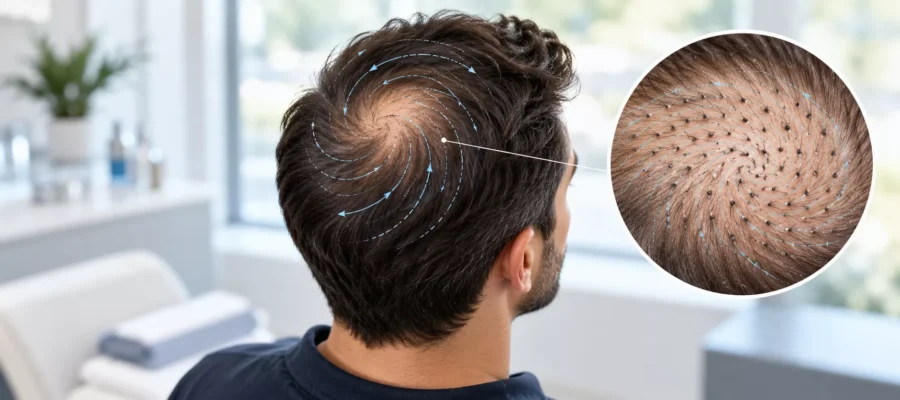
A thinning crown can look worse in photographs than in the bathroom mirror. Overhead lighting exaggerates visible scalp, prompting many people to consider a crown hair transplant. Yet restoring the back of the head is not the same as rebuilding a receding hairline.
The crown, also called the vertex, has its own growth pattern, shape and long-term challenges. Hair travels around a central swirl rather than falling neatly in one direction. Hair loss can keep spreading, while donor follicles remain limited. Planning means considering more than today’s bald patch; the strategy should still make sense years later.
The Crown Is Not Just Another Bald Area
The frontal scalp provides a relatively predictable visual frame. Hair can overlap in a familiar direction, helping create an impression of fullness. The crown is different. Its curved surface is visible from above, and the natural hair pattern spreads out in several directions. Light can reach the scalp between strands, even when considerable hair remains.
Crown hair transplant planning therefore calls for photographs from several angles. The surgeon assesses the thinning centre, surrounding mid-scalp and hair direction. A small-looking circle can involve a surprisingly large surface.
Recreating the Natural Crown Whorl
Look closely at a healthy crown and you will notice a spiral, or whorl. In some people it rotates clockwise; in others it turns the opposite way. A few people have more complex patterns. These differences guide the creation of recipient sites.
If grafts are placed in straight rows or at conflicting angles, the hair may stand awkwardly or become difficult to style. Accurate placement follows the remaining native hairs wherever possible, allowing the transplanted strands to blend into the swirl. The aim is not a perfectly filled circle. It is a crown that looks convincing when the hair is dry, wet, short or viewed from behind.
Crown Density Versus Hairline Density
A natural-looking result is not simply the highest possible graft density. Hair thickness, curl, colour contrast and the number of hairs within each follicular unit all influence how much scalp is visible. Someone with coarse, wavy hair may achieve stronger visual coverage than someone with very fine, straight hair using a similar graft count.
| Planning Feature | Frontal Hairline | Crown or Vertex |
|---|---|---|
| Main cosmetic goal | Frame the face | Reduce visible scalp |
| Hair direction | Mostly forward or diagonal | Rotating whorl |
| Appearance | Seen mainly face-on | Seen from above and behind |
| Graft strategy | Shape and soft transitions | Distribution and donor conservation |
These differences matter when comparing before-and-after photographs. A frontal result can look full because neighbouring hairs overlap. In the crown, that same optical effect is harder to create across a rounded surface.
How Surgeons Estimate Crown Graft Requirements
There is no reliable universal number of grafts for crown restoration. Two patients with similarly sized thinning areas may need different plans because one still has strong native hair while the other has extensive miniaturisation. The number of follicles available for safe extraction is just as important as the space requiring coverage.
| Assessment Factor | Why It Changes the Plan |
|---|---|
| Area of thinning | Larger surfaces increase graft demand |
| Existing hair | Remaining density affects the distribution |
| Hair calibre and curl | Influence the appearance of fullness |
| Whorl direction | Guides implantation angle and orientation |
| Donor quality | Sets practical extraction limits |
| Future hair loss | May require reserving grafts |
One follicular-unit graft may contain several hairs. An advertised graft count alone cannot predict natural-looking, sustainable coverage.
Protecting the Donor Area for the Future
Donor hair is not an unlimited resource. Most scalp procedures take follicles from the back and sides of the head, where hair is often more resistant to androgenetic hair loss. Every extraction reduces the follicles available for a later procedure. Removing too many can also make the donor region look visibly thin.
This becomes especially important when the crown and hairline are both affected. A patient may be eager to cover the vertex immediately, yet a surgeon may recommend strengthening the frontal or mid-scalp areas first. The priority depends on age, existing hair loss, donor capacity and personal goals. A sensible hair transplant plan balances today’s improvement with possible needs five or ten years down the road.
Planning Around Progressive Hair Loss
A transplant relocates follicles; it does not stop untreated native hair from thinning. The crown is particularly vulnerable to this problem because loss can spread outward from the original patch. If the central area is restored but the surrounding hair disappears later, a noticeable ring of thinning may develop.
That is why candidacy matters as much as surgical technique. A clinician may assess whether the loss is still active and discuss suitable treatments to preserve existing hair. Depending on the diagnosis, options may include medications such as minoxidil or finasteride, with benefits and potential adverse effects reviewed individually. For some patients, monitoring the pattern before operating is more prudent than rushing into an extensive crown procedure.
FUE and DHI Techniques for Crown Restoration
Both FUE hair transplantation and DHI hair transplantation can be considered for crown restoration. FUE describes the extraction of individual follicular units, while DHI generally refers to placement with a specialised implanter. In practice, the two approaches share important steps, and neither technique automatically guarantees a denser crown.
The more meaningful questions concern the medical team’s experience, graft handling and control of angle, depth and direction. Working among existing miniaturised hairs also requires care to avoid unnecessary injury. A clinic should explain why its proposed approach suits the actual scalp, rather than promising that a particular tool will solve every challenge.
Crown Hair Transplant Recovery and Results
The first days after surgery usually involve tiny scabs, sensitivity and some redness. Transplanted hair shafts may then shed during the following weeks. This can be unsettling, especially when someone expected the freshly implanted coverage to remain visible, but early shedding is a recognised part of the growth cycle.
| Period | Common Changes |
|---|---|
| First 1–2 weeks | Scabs gradually clear; scalp heals |
| Weeks 2–8 | Transplanted shafts may shed |
| Months 3–4 | Early new growth may appear |
| Months 6–9 | Coverage gradually becomes more noticeable |
| Months 12–18 | Many crown results can be assessed more reliably |
These periods are approximate, not deadlines. Crown growth can look uneven before the transplanted hair thickens and matures. Follow the clinic’s washing and activity instructions, and contact the medical team if pain intensifies, redness spreads or there is discharge or fever.
Realistic Expectations for Crown Coverage
People sometimes arrive at a consultation holding a photograph of a completely dense crown. The understandable temptation is to ask for that exact result. However, transplanted density rarely matches someone’s original, unaffected hair, particularly across a large vertex. An improvement in scalp coverage may be both worthwhile and more achievable than complete concealment under every light.
Hairstyle also affects the outcome. Longer strands can overlap more effectively, while very short cuts and bright overhead lighting expose gaps. When looking through hair transplant before-and-after results, compare photographs taken at similar angles, hair lengths and lighting conditions. Consistency reveals more than a single flattering image.
When a Staged Approach Makes Sense
Some crowns can be treated in one operation; others need conservative coverage and reassessment. Staging can help when the donor supply is limited, thinning is extensive or future recession is uncertain.
Choosing not to fill every square centimetre at once is not necessarily a compromise in quality. It can be a deliberate way to protect the donor supply and avoid an unnatural boundary as neighbouring hair changes. Capilclinic’s consultation team can be contacted to begin a discussion, although the final surgical decision requires an individual clinical examination.
Frequently Asked Questions
Why Can a Crown Hair Transplant Require More Grafts Than Expected?
- The crown covers a curved surface that can be larger than it appears in photographs.
- Its spiral growth pattern makes even coverage harder to achieve with overlapping hair.
- Existing thinning and hair characteristics change how grafts must be distributed.
- A safe plan must consider the entire scalp, not just the central bald spot.
Is a Crown Hair Transplant Suitable for Everyone?
- Candidates need adequate donor hair and a medically appropriate diagnosis.
- Continuing hair loss should be assessed before grafts are allocated.
- Expectations should reflect achievable coverage, not guaranteed original density.
- Some people benefit more from medical treatment, monitoring or postponing surgery.