



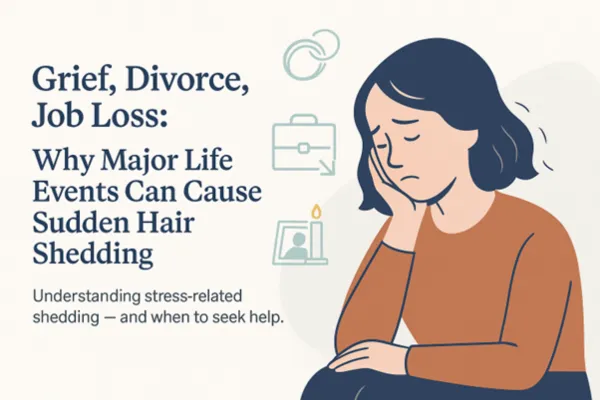
When life turns upside down, a loved one dies, a marriage ends, a job disappears the impact isn’t only emotional. Many people notice something else a few weeks or months later: sudden, diffuse hair shedding. Hair shows up on the pillow, in the shower, on the hairbrush in worrying amounts.
Doctors often call this pattern telogen effluvium – a temporary shedding where more hairs than usual enter the “resting” and shedding phase after a major stress to the body or mind.
Major life events like bereavement, divorce, and job loss are well-recognised triggers for this kind of stress-related shedding. Understanding why this happens can make the experience feel less frightening and help you know when to simply watch and wait, and when to seek professional help.
Understanding Sudden Hair Shedding
What is sudden shedding?
Sudden hair shedding is usually:
- Diffuse – hair thins all over the scalp rather than in clear patches or a receding hairline
- Delayed – it often starts 2–3 months after a major stress or life event, not immediately
- Noticeable – more hair in the drain, on your hands when shampooing, or on your brush than you’re used to
In telogen effluvium, a stressor (like grief, surgery, infection, crash dieting, or emotional shock) pushes more hairs than normal into the telogen (resting) phase. A few months later, those hairs shed together. Most people recover over 3–6 months once the trigger settles and overall health stabilises.
Emotional and physical manifestations
Sudden shedding doesn’t happen in isolation. People often describe:
- Heightened anxiety about the mirror or the shower drain
- Checking the hairline or parting repeatedly
- Trouble sleeping, appetite changes, or digestive issues
- Head, neck, and scalp tension from chronic stress
Hair loss itself can become a second stressor, feeding a loop of worry (“Am I going bald?”) that makes coping with the original life event even harder.
The mind–hair connection
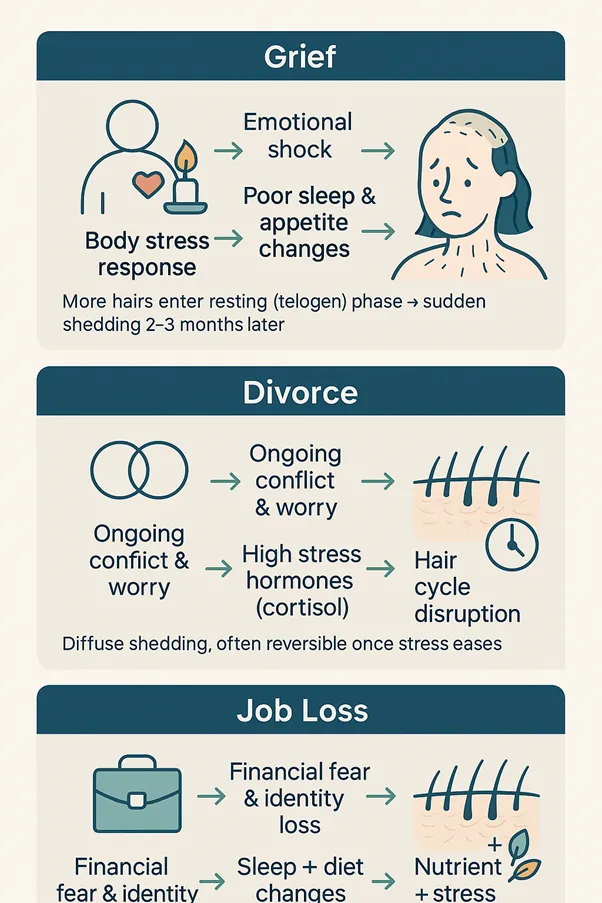
In grief, divorce, or job loss, the body shifts into a prolonged stress response. Elevated stress hormones, disrupted sleep, changes in eating patterns, and weight changes all affect the hair cycle and scalp health, increasing the risk of telogen effluvium.
Grief
What is grief?
Grief is the emotional, mental, and physical response to losing someone or something deeply important. People often move through overlapping stages such as shock, denial, anger, bargaining, sadness, and gradual acceptance. There is no “right” way or timeline.
How grief can trigger sudden shedding?
Bereavement is one of the classic triggers for telogen effluvium. Grief can cause:
- Severe emotional stress – intense sadness, fear, or guilt
- Disrupted sleep – difficulty falling or staying asleep
- Changes in appetite and weight – eating very little or, sometimes, overeating
- Immune and hormonal shifts – the body is in a state of “alarm” for weeks or months
Together, these factors can push a larger proportion of hairs into the resting phase. A couple of months later, shedding starts, just when you might be trying to feel “functional” again.
Emotional release and physical change
For some, noticing hair shedding becomes part of the grief story:
- “My hair is falling out because I’m not myself right now.”
- “I see the loss every time I wash my hair.”
It can feel like your body is visibly showing how much you’ve been through. That doesn’t mean the shedding is permanent — but the feelings are real and valid.
Coping mechanisms and support
Alongside grief counselling or therapy, it can help to:
- Stabilise basic routines
- Aim for regular meals with enough protein, iron-rich foods, and healthy fats
- Prioritise sleep hygiene (consistent wake/sleep time, screen breaks before bed)
- Treat your hair gently
- Avoid tight hairstyles, harsh chemical treatments, or aggressive brushing
- Use a mild shampoo and avoid very hot water on the scalp
- Share what’s happening
- Let trusted people know you’re dealing with both grief and hair shedding
- Consider speaking to a GP or dermatologist if shedding is heavy or prolonged
If shedding continues beyond 6 months, or you notice clear thinning at the front or crown, it’s sensible to seek a specialised assessment to rule out other causes like androgenetic alopecia or nutrient deficiencies.
Divorce
The emotional impact of divorce
Divorce is rarely just a legal process. It can bring:
- Chronic conflict or tension before and after separation
- Changes in living situation, finances, and parenting
- Feelings of failure, guilt, rejection, or shame
- A deep question of “Who am I now?”
This ongoing emotional strain keeps the body in a high-alert state, which is exactly the environment in which stress-related shedding can appear.
Divorce and sudden shedding
For some people, divorce acts as:
- A single large stressor (e.g., a sudden separation)
- Or a series of smaller stressors over many months (lawyers, moving home, custody arrangements, social changes)
In both scenarios, the hair cycle is sensitive to the cumulative load. Shedding that starts a few months into or after a divorce process is a common pattern in telogen effluvium.
Identity, appearance, and self-perception
Ending a long-term relationship often changes how people see themselves. Hair can feel closely tied to:
- Attractiveness and desirability
- Professional image and confidence at work
- A sense of continuity (“I’ve always had thick hair; now even that feels unstable”)
This means that shedding can affect not just how you look, but how safe or “worthy” you feel in new social or romantic situations.
Social support challenges
Divorce can shrink support networks. Some people lose friends, in-laws, or social routines all at once. Talking about “vanity issues” like hair can feel embarrassing when you’re also dealing with lawyers, children, or housing. But it’s not superficial rather about body image and self-respect during a vulnerable time.
Healthy ways to cope
- Protect the basics
- Don’t skip medical check-ups or blood tests just because “hair seems minor”
- Avoid crash diets to “reinvent” your body quickly; rapid weight loss is another TE trigger
- Rebuild identity gently
- Choose low-stress hairstyles that make you feel put together without pulling on the roots
- Explore small, reversible changes (like a softer cut) instead of drastic chemical treatments
- Seek expert reassurance
- If you’re unsure whether you’re seeing temporary shedding or early pattern hair loss, an evaluation with a hair specialist can provide clarity and a plan
Job Loss
Psychological implications of job loss
Losing a job often combines several stressors at once:
- Financial uncertainty
- Loss of structure and daily routine
- Fear about future employability
- A sharp drop in self-esteem (“If they let me go, maybe I’m not good enough”)
These pressures can keep stress hormones high for weeks or months, especially if a job search is long or the economic climate is uncertain.
Job loss and sudden shedding
Any major life event that disrupts sleep, appetite, and emotional stability can trigger telogen effluvium, and job loss is no exception. The pattern is similar:
- Stress and lifestyle upheaval →
- Hair cycle disruption →
- Increased shedding a few months later
This sometimes appears right when someone finally lands a new role or starts interviewing more often, just when they’d like to feel most confident.
Effects on self-esteem and identity
Work is a big part of many people’s identity. When job loss and hair shedding happen in the same period, people can feel:
- “I don’t recognise myself in the mirror.”
- “I already feel rejected professionally; now I look more tired and older as well.”
This combination can fuel avoidance of networking, interviews, or social events, which in turn can slow recovery.
Behavioural changes that affect hair
After job loss, it’s common to see changes such as:
- Staying up much later, doom-scrolling or worrying
- Skipping balanced meals or relying on convenience food
- Increasing caffeine, nicotine, or alcohol intake to “cope”
- Avoiding exercise or time outdoors
All of these can affect scalp circulation, hormones, and nutrient status, further worsening shedding risk.
Strategies for coping and rebuilding
- Reintroduce gentle structure
- Fixed wake/sleep times
- One simple routine for meals, movement, and self-care
- Protect hair and scalp health
- Ensure adequate protein, iron, and B vitamins in the diet
- Avoid tight caps or styles worn all day at home
- Separate self-worth from job title
- Therapy, coaching, or peer support groups can help rebuild identity beyond the CV
- Know when to seek medical input
- If shedding persists or you’re also seeing a receding hairline or crown thinning, a specialist evaluation is worthwhile
The Interplay Between These Events
Major life events rarely occur in isolation. Grief, divorce, and job loss can:
- Overlap – e.g., a bereavement that contributes to relationship strain, or job loss in the middle of a difficult separation
- Cascade – one event increases financial or emotional pressure, which increases the risk of another
The common threads are:
- Emotional upheaval
- Changes in routine, nutrition, and sleep
- Ongoing uncertainty
From your hair’s perspective, all of these add up to stress load. Some people are more sensitive to this load because of their genetics, hormones, underlying health, or existing pattern hair loss. For them, telogen effluvium may be more noticeable or last longer, and it may unmask an underlying tendency to androgenetic alopecia.
If you’d like to understand telogen effluvium in more detail, including typical timelines and recovery expectations, you may also find Capilclinic’s article “Stress and Hair Loss: Is Telogen Effluvium Reversible?” helpful as a companion read.
Conclusion
Sudden hair shedding after grief, divorce, or job loss is not “all in your head,” and it’s not a sign that you’re vain or overreacting. It is a well-recognised, physiological response called telogen effluvium, in which the hair cycle temporarily shifts under emotional and physical strain.
Key points to remember:
- Shedding often appears 2–3 months after the main stressor.
- In many cases, it is temporary, settling over 3–6 months once life and health stabilise.
- Persistent shedding, visible thinning at the hairline/crown, patchy bald spots, scalp pain, or shedding that continues beyond six months deserve a professional evaluation.
During difficult transitions, looking after your mental health, sleep, and nutrition is just as important as what you put on your scalp. There is no shame in asking for help — from therapists, support groups, GPs, or hair restoration specialists.
If you’re worried that your shedding isn’t improving or might be revealing an underlying hair loss condition, you can book a confidential consultation with Capilclinic’s hair restoration team in Istanbul to get a clear diagnosis and a personalised plan, whether that involves medical treatment, monitoring, or, when appropriate, hair transplantation.
This article is for information only and does not replace individual medical advice. Always discuss sudden or severe hair loss with a healthcare professional.
At Capilclinic, we’re trusted by thousands of patients in the UK and Europe as a leading Hair Transplant Clinic in Turkey and Spain, known for our expert doctors, advanced facilities, natural hairline results, and affordable all-inclusive packages. Reach out to our team today to start your transformation.